
Clear safety zones around equipment should follow manufacturer and facility guidance.
Indoor Facility
Gymnasium & Fitness
Flexible gym and fitness zones planned around equipment clearance, safety, and multi-use programming.
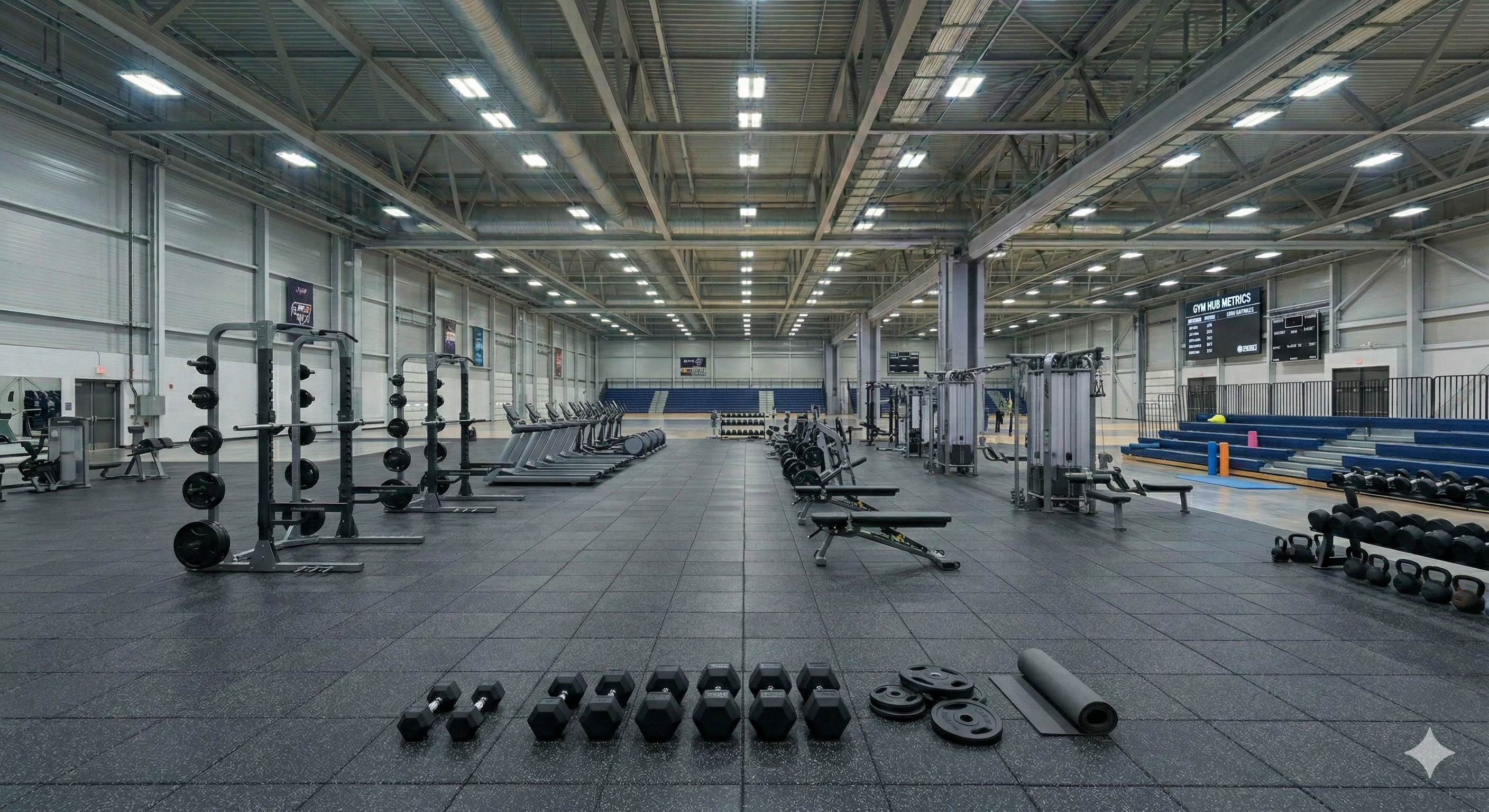
What Is a Gymnasium & Fitness Centre Facility?
A well-designed gymnasium or fitness centre is not just about equipment — it's about the floor, the zones, the lighting, the ceiling height, and the overall experience. Whether you're building a school gym, a corporate wellness centre, or a commercial fitness facility, the sports flooring is the foundation of every session.
Sports gymnasium floors need to handle heavy equipment (treadmills, weight racks, barbells) without damage, provide cushioning for functional training zones, and have a non-slip surface for aerobics and fitness classes. Rubber gym flooring in different thicknesses is the global standard, with PVC vinyl for cardio zones.
Durosport supplies and installs gymnasium-grade rubber flooring, strength training platforms, and functional training surfaces for schools, universities, corporate campuses, and commercial gyms. We also handle the sports lighting, mirror systems, and sports-specific wall padding.
How Much Does a Gymnasium & Fitness Centre Facility Cost in India?
| Facility Type | Approx. Cost (INR) | Timeline |
|---|---|---|
| School Gymnasium (rubber flooring, 200 sqm) | ₹6 – 12 Lakhs | 2–4 weeks |
| Corporate Fitness Centre (300 sqm) | ₹12 – 25 Lakhs | 4–6 weeks |
| Commercial Gym Flooring (500 sqm) | ₹20 – 45 Lakhs | 6–10 weeks |
| Functional Training / CrossFit Zone | ₹8 – 18 Lakhs | 3–5 weeks |
⚠ Equipment (treadmills, weight machines) is not included in above flooring and fitout costs. Above ranges cover flooring, lighting, mirrors, and basic fitout. Indicative India 2025–26 pricing.
What Does a Gymnasium & Fitness Centre Build Include?
- Sub-floor preparation and levelling
- Heavy-duty rubber flooring installation (12–20mm for weights zone, 6–8mm for cardio)
- Hardwood or PVC vinyl for aerobics / group fitness studio
- Strength training platforms (customised deadlift/Olympic lifting areas)
- LED sports lighting for gym (≥300 lux, glare-free)
- Full-length gym mirror panels and stainless steel brackets
- Wall padding / foam padding for functional training areas
- HVAC guidance and ventilation recommendations
Dimensions & Standards
Sports hall module34.5 m x 20.0 m (113 ft x 66 ft)
Court Line Markings
Court linesVaries by sport and program
Recommended Buffer / Run-Off
Surfaces Used
Rubber flooring
PVC sports vinyl
PU systems
Certifications & Standards
Facility Guidance
Design & Performance Notes
Gymnasium planning balances circulation, safety zones, and ventilation to support a mix of fitness and training activities.
Flooring is selected based on impact resistance and acoustic control to create comfortable, durable workout environments.
Typical Build Scope
Sub-Base Work
Top Flooring: Rubber flooring, PVC sports vinyl, PU systems
Lighting
Accessories / Civil Works
Planning Framework for Gymnasium & Fitness Projects
High-performance Gymnasium & Fitness facilities are built through a sequence of design, engineering, and execution decisions. The first step is a technical feasibility review of the site: available footprint, soil behavior, water movement, utility lines, access points for equipment, and expected user load. This early assessment helps prevent downstream rework and allows the project team to make realistic budget and timeline commitments.
Next, Durosport aligns the design intent to your operating model. A school, academy, club, developer, and government body each require a different balance of performance, durability, maintenance frequency, and lifecycle cost. For Gymnasium & Fitness projects, this means selecting the right surface stack-up, defining sub-base tolerances, planning drainage and slope control, and specifying ancillary infrastructure so the facility performs consistently from day one.
Procurement and installation quality control are equally important. Material approvals, mock-up validation, layer thickness checks, and tolerance measurements at each milestone reduce technical risk. Instead of treating handover as the finish line, we define a commissioning checklist that includes gameplay validation, user safety checks, and a preventive maintenance SOP so the facility retains performance over years of use.
If you are evaluating a new build versus a resurfacing path, compare options using long-term operating cost, downtime during execution, and certification goals where applicable. This gives decision-makers a practical framework rather than choosing only on upfront capex.
Implementation Roadmap, Internal Links, and Next Steps
For most Gymnasium & Fitness projects, implementation is strongest when workstreams run in parallel: design finalization, civil preparation, material planning, and compliance documentation. Teams that sequence these streams clearly reduce delays and keep the site ready for each specialized crew. Durosport can support complete turnkey delivery or coordinate with your architect and PMC under a defined QA workflow.
To evaluate technical options in detail, start with rubber flooring systems, gym mat packages, and indoor structural planning. These pages help you compare systems and define specifications that match your usage pattern, climate exposure, and maintenance bandwidth.
For budget planning, use the sports facility cost guide to set a realistic range before BOQ finalization. When you are ready to convert this into a project-specific proposal, submit your site details through the free consultation form and our team will share an itemized, execution-ready recommendation.
Every project also benefits from documenting post-installation maintenance and yearly inspection checkpoints. This ensures surface integrity, player safety, and predictable performance throughout the asset lifecycle.
Frequently Asked Questions
What type of flooring is best for a gymnasium?
Rubber flooring is the industry standard globally. For weights and strength training zones, 20–25mm thickness rubber tiles or rolls provide impact protection for dropped weights. For cardio zones, 6–8mm rubber or PVC vinyl is sufficient. Group fitness studios use 8–10mm rubber or sprung wood floors for aerobics and yoga classes.
What is the minimum ceiling height for a gymnasium?
For a general fitness gymnasium, 3.5m clear ceiling height is the minimum. For gymnastics training (requiring apparatus), a minimum of 8m is required. For CrossFit and functional training with rope climbs, 5–6m is needed. School gymnasiums for PE classes work well at 4–4.5m.
How do I choose between rubber tiles and rubber rolls for the floor?
Rubber tiles (typically 1m × 1m, 20–25mm thick) are easier to replace in high-wear zones and can be installed without adhesive (dry-lay). Rubber rolls cover large areas faster and have fewer seams but require adhesive. For most gyms, tiles are preferred in the free weights zone and rolls in the cardio zone.
What is a strength training platform?
A strength training platform is a raised, engineered floor section in the Olympic lifting / deadlift area of a gym. It consists of a plywood base topped with solid rubber (40–50mm) in the centre and wood or rubber on the sides. The platform absorbs the impact of heavy barbell drops, protecting the main gym floor.
Do I need sports lighting specifically for a gymnasium?
Yes — general office or warehouse lighting is not adequate for gymnasiums. Sports lighting provides higher lux levels (300–500 lux for gyms), better colour rendering (CRI ≥80), and reduced glare which is important in gym environments. LED panels with diffuser covers are the standard for modern gymnasium installations.
Explore Related Pages
🏗️ Surface Materials
🏟️ Related Sports
Get a call from our team for a quotation
Tell us about your project and we will recommend the right surface and standards.
Request a call