
Minimum separation between a swimming pool and diving well: 5.0 m (8–10 m preferred for new pools).
Indoor + Outdoor Sport
Swimming Pools
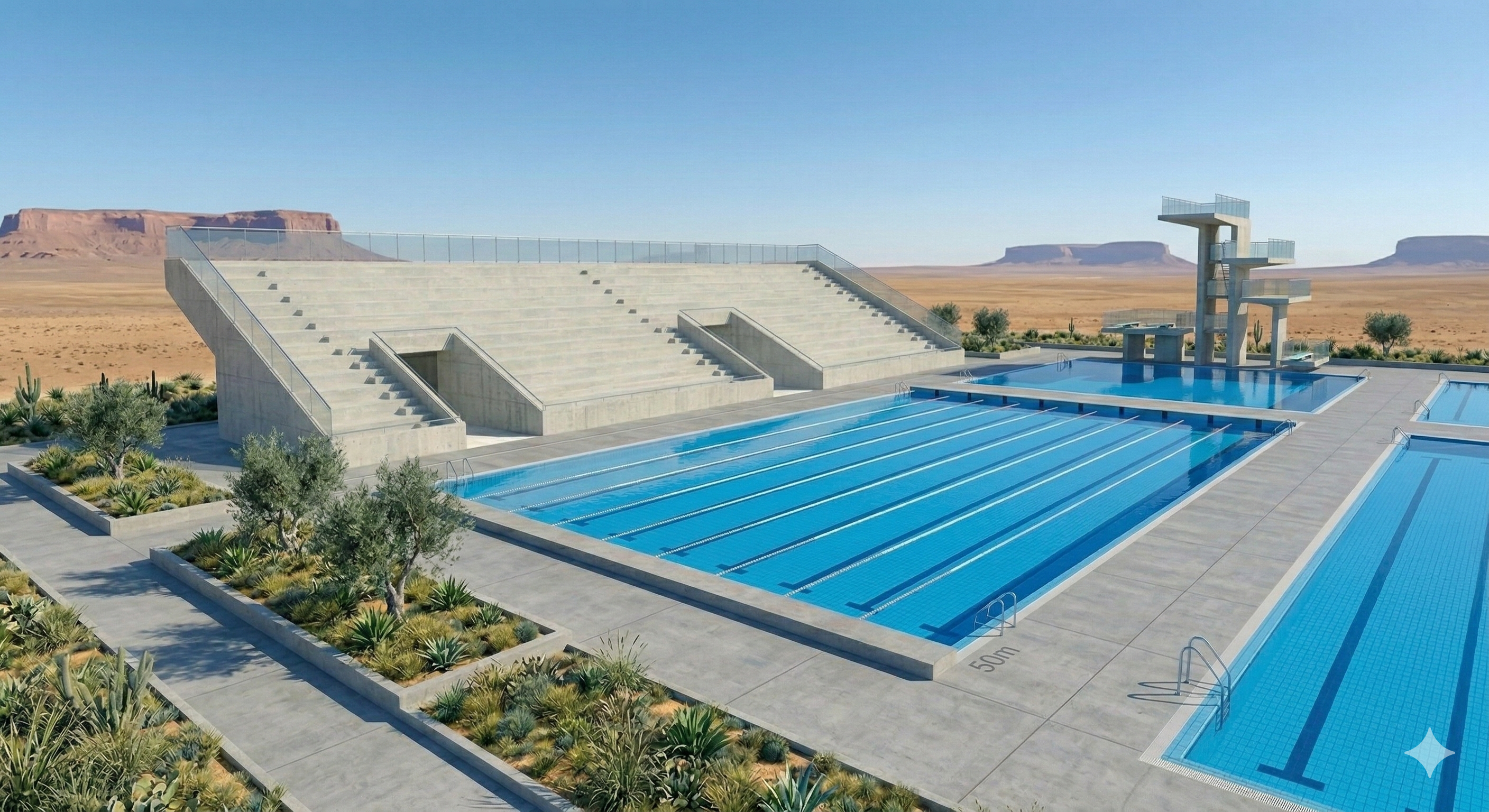
Competition and training pools designed to World Aquatics facility requirements with precise lane geometry.
What Is a Swimming Pool Facility?
A competition swimming pool is one of the most technically demanding construction projects in sports infrastructure. The pool must meet precise dimensional requirements, maintain water temperature, have competition-quality lane ropes and timing systems, and comply with FINA (World Aquatics) specifications for certified competition.
In India, swimming pool projects span from 25m school pools to 50m Olympic-standard competition pools. Recreational and hotel pools have different requirements from competition pools. The key factors are: pool type (competition vs leisure), surface finish (tiles, marbelite, fibreglass), filtration system quality, and deck material.
Durosport provides consultation, design, and project management for competition swimming facilities — coordinating with specialised pool construction contractors and aquatics engineers to deliver pools that meet school, university, state, and national competition standards.
How Much Does a Swimming Pool Facility Cost in India?
| Facility Type | Approx. Cost (INR) | Timeline |
|---|---|---|
| 25m × 10m Pool (school, 4-lane) | ₹60 Lakhs – 1.5 Crore | 20–32 weeks |
| 25m × 16m Pool (club, 6-lane) | ₹1 – 2 Crore | 24–36 weeks |
| 50m × 25m Olympic Pool (8-lane) | ₹3 – 8 Crore | 36–52 weeks |
| Leisure/Hotel Pool (custom shape) | ₹40 – 150 Lakhs | 16–28 weeks |
⚠ Pool construction costs depend heavily on finishing quality, filtration system, deck area, changing room/clubhouse infrastructure, and water heating. Above ranges are for pool shell, tiling, filtration, and deck — building structure is additional. Indicative India 2025–26 pricing.
What Does a Swimming Pool Build Include?
- Pool shell structural design and engineering
- RCC construction with waterproofing membrane
- Ceramic tile or marbelite interior finish
- Competition-grade stainless steel pool fittings (inlets, drains, overflow channels)
- Lane rope system and anchor points
- Starting block installation
- Turnwall touch panels and timing system interface (competition pools)
- Filtration and chemical treatment system
- Pool deck in anti-slip tile, concrete, or pool surrounds
- Underwater lighting and safety provisions
Dimensions & Standards
Olympic pool50.00 m x 25.00 m (164 ft x 82 ft)
Court Line Markings
Lane marking width0.20–0.30 m
Lane center spacing2.50 m
Cross lines15 m from each end wall
Target line lengthup to 3 m on end wall
Recommended Buffer / Run-Off
Surfaces Used
Ceramic tile finishes
Anti-slip deck systems
Stainless or concrete pool shells
Certifications & Standards
World Aquatics
Design & Performance Notes
Pool design focuses on water quality, wall alignment, and accurate lane markings for competition timing.
Deck drainage, non-slip finishes, and mechanical systems are engineered for long-term operational efficiency.
Typical Build Scope
Sub-Base Work
Top Flooring: Ceramic tile finishes, Anti-slip deck systems, Stainless or concrete pool shells
Fencing
Lighting
Accessories / Civil Works
Planning Framework for Swimming Pools Projects
High-performance Swimming Pools facilities are built through a sequence of design, engineering, and execution decisions. The first step is a technical feasibility review of the site: available footprint, soil behavior, water movement, utility lines, access points for equipment, and expected user load. This early assessment helps prevent downstream rework and allows the project team to make realistic budget and timeline commitments.
Next, Durosport aligns the design intent to your operating model. A school, academy, club, developer, and government body each require a different balance of performance, durability, maintenance frequency, and lifecycle cost. For Swimming Pools projects, this means selecting the right surface stack-up, defining sub-base tolerances, planning drainage and slope control, and specifying ancillary infrastructure so the facility performs consistently from day one.
Procurement and installation quality control are equally important. Material approvals, mock-up validation, layer thickness checks, and tolerance measurements at each milestone reduce technical risk. Instead of treating handover as the finish line, we define a commissioning checklist that includes gameplay validation, user safety checks, and a preventive maintenance SOP so the facility retains performance over years of use.
If you are evaluating a new build versus a resurfacing path, compare options using long-term operating cost, downtime during execution, and certification goals where applicable. This gives decision-makers a practical framework rather than choosing only on upfront capex.
Implementation Roadmap, Internal Links, and Next Steps
For most Swimming Pools projects, implementation is strongest when workstreams run in parallel: design finalization, civil preparation, material planning, and compliance documentation. Teams that sequence these streams clearly reduce delays and keep the site ready for each specialized crew. Durosport can support complete turnkey delivery or coordinate with your architect and PMC under a defined QA workflow.
To evaluate technical options in detail, start with wet-area compatible flooring, water management infrastructure, and pool lighting packages. These pages help you compare systems and define specifications that match your usage pattern, climate exposure, and maintenance bandwidth.
For budget planning, use the sports facility cost guide to set a realistic range before BOQ finalization. When you are ready to convert this into a project-specific proposal, submit your site details through the free consultation form and our team will share an itemized, execution-ready recommendation.
Every project also benefits from documenting post-installation maintenance and yearly inspection checkpoints. This ensures surface integrity, player safety, and predictable performance throughout the asset lifecycle.
Frequently Asked Questions
What are the dimensions of an Olympic swimming pool?
An Olympic (FINA/World Aquatics) 50m pool is 50m × 25m with 10 lanes (each 2.5m wide). The water depth must be at least 2m. A 25m competition pool (short course) has the same 25m width with 10 lanes. School pools are typically 25m × 10–12m with 4–5 lanes.
How much space does a swimming pool facility need?
A 25m × 10m pool itself needs 250 sqm of water area. The deck around the pool (minimum 4m on each side), changing rooms, plant room, and spectator/parent seating area mean the total site requirement is typically 40m × 30m for a basic school pool, and 80m × 50m+ for a competition facility.
What is the lifespan of a swimming pool?
A well-constructed RCC pool shell lasts 25–40 years. The tiling and finishing may need re-grouting or replacement every 15–20 years. The filtration and pump system has a 10–15 year lifespan. Annual maintenance (chemical treatment, filter backwash, deck upkeep) costs approximately ₹5–15 Lakhs/year depending on pool size.
What filtration system is recommended for a competition pool?
Sand filtration with UV and chlorine dosing is the standard for most Indian competition pools. Commercial pools use automated chemical dosing systems. For water conservation, a recirculation system with backwash recovery is recommended. Pool water temperature is maintained between 25–28°C for competition (FINA standard).
How long does it take to build a swimming pool?
A school 25m pool takes 20–32 weeks from site handover to water filling. A 50m Olympic pool takes 36–52+ weeks. The timeline depends on: RCC curing periods, specialised equipment lead times (starting blocks, timing systems), and finishing work. We recommend planning at least 12 months in advance for a competition pool project.
Explore Related Pages
🏗️ Surface Materials
🏟️ Related Sports
Get a call from our team for a quotation
Tell us about your project and we will recommend the right surface and standards.
Request a call