
Minimum playing surface 9.14 m x 18.29 m (30 ft x 60 ft); recommended 10 ft margin gives 12.19 m x 19.51 m (40 ft x 64 ft).
Indoor + Outdoor Sport
Pickleball
Fast-growing pickleball courts built to official line dimensions with consistent ball bounce and player traction.
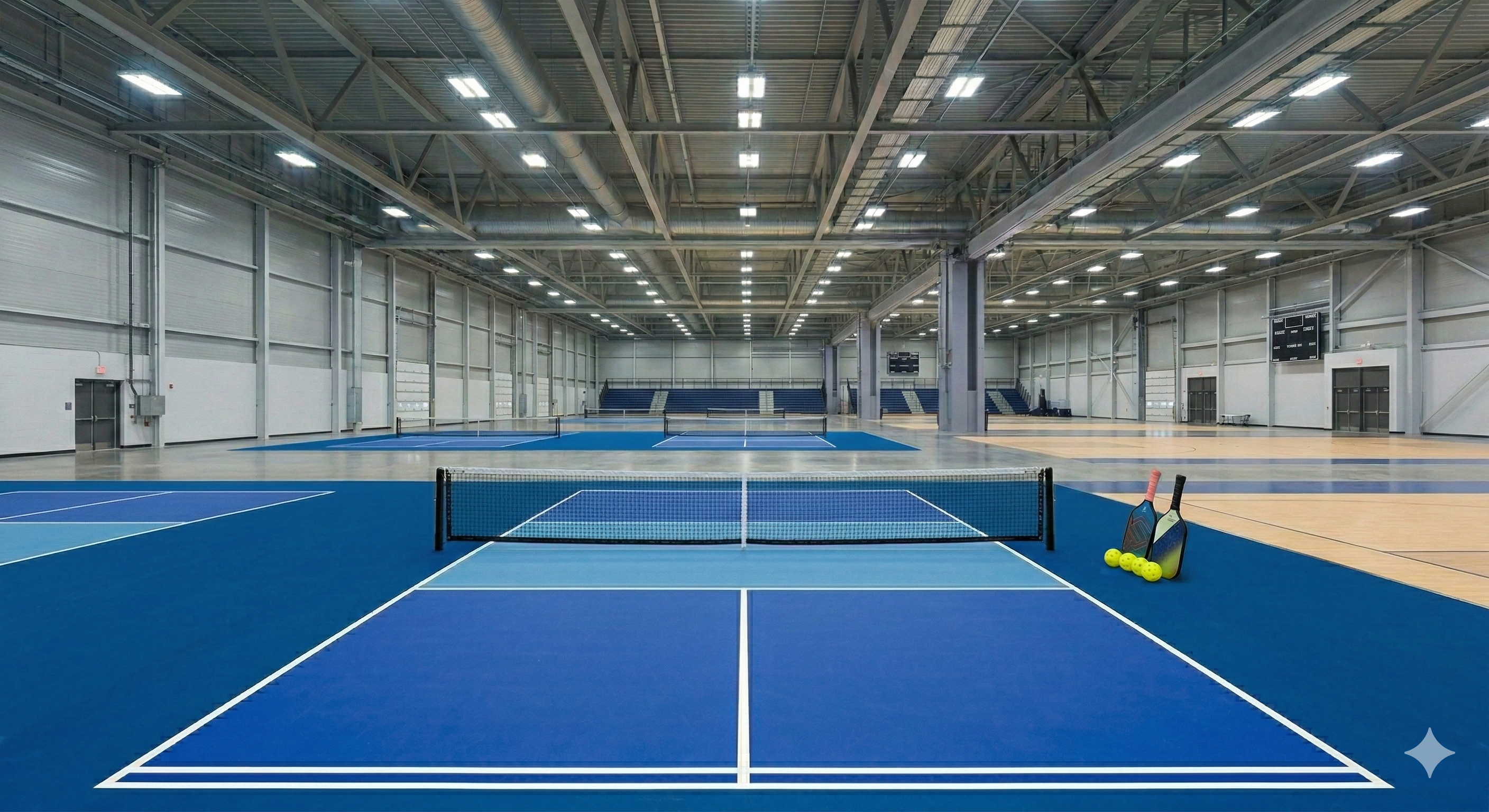
What Is a Pickleball Facility?
Pickleball is the fastest-growing sport in India right now. It combines elements of tennis, badminton, and table tennis on a compact court that fits almost anywhere. The sport is particularly popular among senior players and corporate wellness programmes because it's easy on the joints and quick to learn.
A pickleball court is 13.41m × 6.10m — almost the same as a badminton doubles court. This means you can often convert an existing tennis court into 4 pickleball courts, or lay a dedicated pickleball surface in spaces that aren't large enough for tennis or basketball.
Durosport builds dedicated pickleball courts as well as multi-use surfaces that include pickleball markings alongside other sports. Acrylic hard court is the standard surface globally and in India, providing the right ball bounce and player traction.
How Much Does a Pickleball Facility Cost in India?
| Facility Type | Approx. Cost (INR) | Timeline |
|---|---|---|
| Single Outdoor Pickleball Court (acrylic) | ₹4 – 8 Lakhs | 2–4 weeks |
| Adding Pickleball Lines to Tennis Court | ₹50,000 – 1.5 Lakhs | 2–5 days |
| 4-Court Pickleball Complex (outdoor) | ₹20 – 35 Lakhs | 6–10 weeks |
| Indoor Pickleball Court (PVC vinyl) | ₹12 – 20 Lakhs | 4–8 weeks |
⚠ Pickleball's small court size makes it one of the most affordable individual court builds. Net posts and nets are a small additional cost. Indicative India 2025–26 pricing.
What Does a Pickleball Build Include?
- Sub-base preparation and concrete levelling
- Acrylic hard court surface (2-colour zoning per pickleball standard)
- Full USA Pickleball Association (USAPA) line markings
- Net post in-ground sleeves with adjustable net system
- USAPA-approved pickleball net
- Court boundary fencing (chain-link or panel, optional)
- LED sports lighting for evening play (optional)
- Non-Kitchen Zone (NTZ/kitchen) tactile indicators (optional)
Dimensions & Standards
Court size13.41 m x 6.10 m (44 ft x 20 ft)
Court Line Markings
Non-volley zone (NVZ)2.13 m (7 ft) from net
Net to baseline6.71 m (22 ft)
Court half-width3.05 m (10 ft)
Net height0.914 m (36 in) at sideline; 0.864 m (34 in) at centre
Recommended Buffer / Run-Off
Surfaces Used
Acrylic hard court
Modular tiles
Indoor PU or PVC sports flooring
Certifications & Standards
USA Pickleball
Design & Performance Notes
Pickleball courts thrive on crisp linework and a durable topcoat that can handle high foot traffic and paddles.
We design for multi-use conversions so facilities can serve tennis or badminton when needed.
Typical Build Scope
Sub-Base Work
Top Flooring: Acrylic hard court, Modular tiles, Indoor PU or PVC sports flooring
Fencing
Lighting
Accessories / Civil Works
Planning Framework for Pickleball Projects
High-performance Pickleball facilities are built through a sequence of design, engineering, and execution decisions. The first step is a technical feasibility review of the site: available footprint, soil behavior, water movement, utility lines, access points for equipment, and expected user load. This early assessment helps prevent downstream rework and allows the project team to make realistic budget and timeline commitments.
Next, Durosport aligns the design intent to your operating model. A school, academy, club, developer, and government body each require a different balance of performance, durability, maintenance frequency, and lifecycle cost. For Pickleball projects, this means selecting the right surface stack-up, defining sub-base tolerances, planning drainage and slope control, and specifying ancillary infrastructure so the facility performs consistently from day one.
Procurement and installation quality control are equally important. Material approvals, mock-up validation, layer thickness checks, and tolerance measurements at each milestone reduce technical risk. Instead of treating handover as the finish line, we define a commissioning checklist that includes gameplay validation, user safety checks, and a preventive maintenance SOP so the facility retains performance over years of use.
If you are evaluating a new build versus a resurfacing path, compare options using long-term operating cost, downtime during execution, and certification goals where applicable. This gives decision-makers a practical framework rather than choosing only on upfront capex.
Implementation Roadmap, Internal Links, and Next Steps
For most Pickleball projects, implementation is strongest when workstreams run in parallel: design finalization, civil preparation, material planning, and compliance documentation. Teams that sequence these streams clearly reduce delays and keep the site ready for each specialized crew. Durosport can support complete turnkey delivery or coordinate with your architect and PMC under a defined QA workflow.
To evaluate technical options in detail, start with acrylic pickleball surfaces, PP tile options, and court lighting standards. These pages help you compare systems and define specifications that match your usage pattern, climate exposure, and maintenance bandwidth.
For budget planning, use the sports facility cost guide to set a realistic range before BOQ finalization. When you are ready to convert this into a project-specific proposal, submit your site details through the free consultation form and our team will share an itemized, execution-ready recommendation.
Every project also benefits from documenting post-installation maintenance and yearly inspection checkpoints. This ensures surface integrity, player safety, and predictable performance throughout the asset lifecycle.
Frequently Asked Questions
What are the dimensions of a pickleball court?
A pickleball court is 13.41m (44 ft) long × 6.10m (20 ft) wide. The non-volley zone (kitchen) extends 2.13m (7 ft) from each end of the net. These dimensions are nearly identical to a badminton doubles court, which makes conversion projects very practical.
Can I fit pickleball on a tennis court?
Yes — a standard tennis court (23.77m × 10.97m) can comfortably fit 2 pickleball courts side by side, or 4 courts in a back-to-back + side-by-side configuration (some trimming of court boundary may apply). We add pickleball lines in a contrasting colour to the existing tennis markings.
Is pickleball suitable for children and seniors?
Absolutely. Pickleball was designed as an inclusive sport. The small court, slower ball speed, and solid paddle make it accessible to children from age 6 and adults of all ages. Many senior residential communities, retirement homes, and corporate campuses are building pickleball courts as their primary racquet sports facility.
What surface is recommended for pickleball?
Acrylic hard court (same as used for tennis and basketball) is the globally recommended surface. The textured acrylic provides good traction, consistent ball bounce, and durability. Concrete or asphalt base with acrylic coating is the standard construction method. Indoor courts use PVC sports vinyl.
How many pickleball courts can fit in one space?
Each court needs approximately 14m × 7m minimum (including small buffer zones). A 30m × 15m area can fit 4 courts. A full pickleball facility with 8 courts needs roughly 60m × 15m. The compact size compared to tennis makes pickleball an efficient use of land for commercial operators.
Explore Related Pages
🏗️ Surface Materials
🏟️ Related Sports
Get a call from our team for a quotation
Tell us about your project and we will recommend the right surface and standards.
Request a call