
Run-off zones are specified by venue design; ensure safety clearance outside outer lane per World Athletics facilities guidance.
Outdoor Sport
Athletic Tracks
World Athletics-compliant 400 m tracks with certified lane widths and high-performance synthetic surfacing.
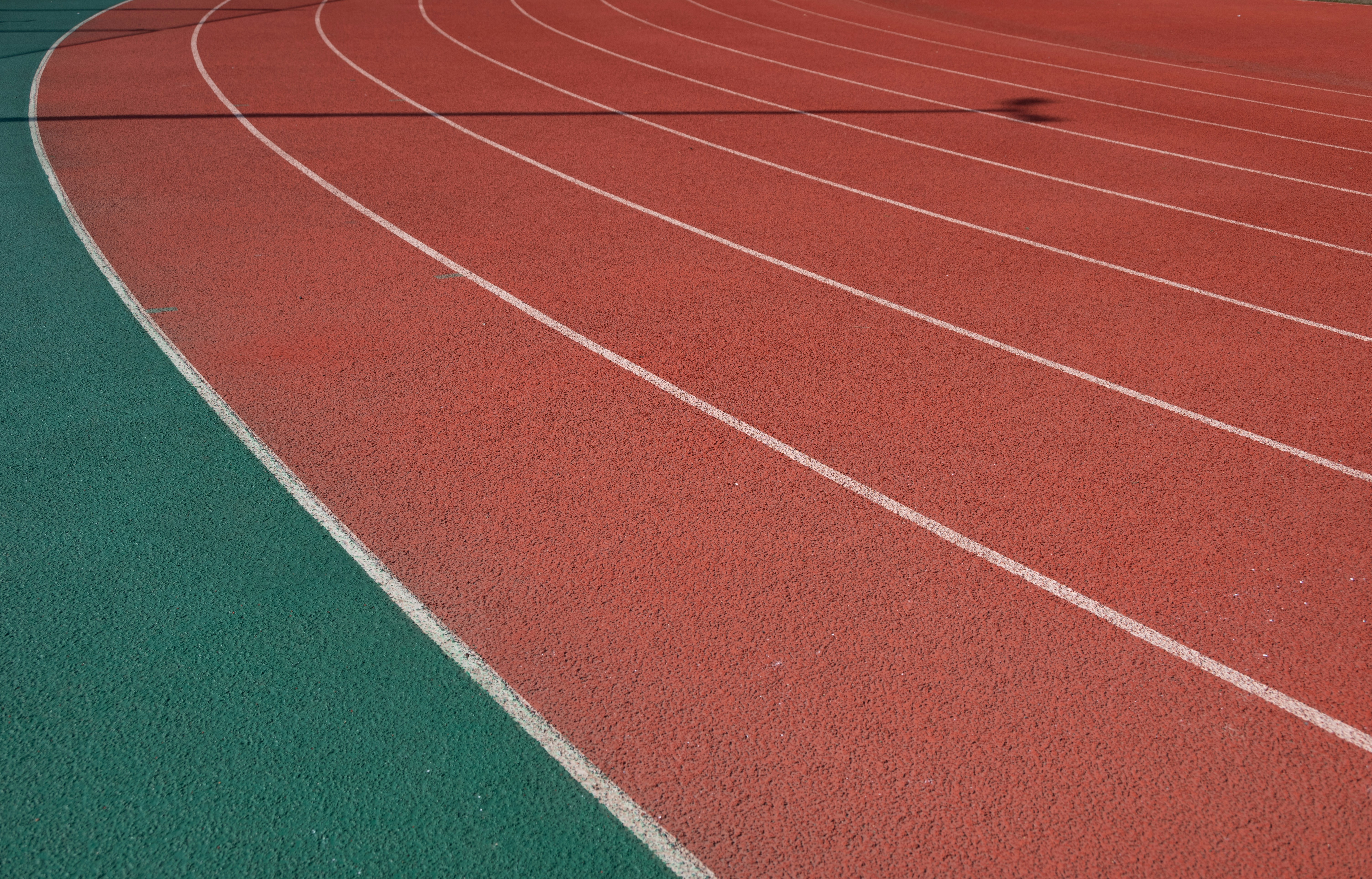
Photo by Allen Jacobsen on Unsplash
What Is a Athletic Track Facility?
An athletic running track is one of the most technically complex sports facilities to build — requiring precise geometry, certified surface materials, exact lane markings, and a well-engineered drainage system. World Athletics (formerly IAAF) certifies tracks for international competition, and state athletics associations have their own standards for district-level competition.
The two main surface options for athletic tracks in India are EPDM rubber (granule-based, coloured red or blue, excellent durability) and PUR (Polyurethane full-pour system, used for World Athletics Class 1 certification). EPDM is the practical choice for schools and colleges; PUR is required for state and national competition venues.
Beyond the 400m main track, a complete athletics facility may include throwing areas (shot put, discus, hammer, javelin), jumping areas (long jump, triple jump, high jump, pole vault), and a steeplechase water jump. Durosport plans and builds full athletics infrastructure from site survey to competition readiness.
How Much Does a Athletic Track Facility Cost in India?
| Facility Type | Approx. Cost (INR) | Timeline |
|---|---|---|
| 8-Lane EPDM 400m Track (school/college) | ₹1 – 2 Crore | 16–24 weeks |
| 8-Lane PUR 400m Track (competition) | ₹2 – 4 Crore | 20–32 weeks |
| Mini Track (200m, 4-lane, EPDM) | ₹35 – 80 Lakhs | 12–18 weeks |
⚠ Throwing areas, jumping areas, and drainage infrastructure are significant additions to the track surface cost. World Athletics certification testing is an additional expense. Indicative India 2025–26 pricing.
What Does a Athletic Track Build Include?
- Survey, site grading, and drainage design
- Compacted aggregate sub-base
- Asphalt binder course
- EPDM rubber granule surface or PUR full-pour system (as selected)
- World Athletics / Khelo India compliant lane markings (all events)
- Sector markings for field events
- Long jump and triple jump runways with sand pit boxes
- Shot put and discus circles (concrete with steel rim)
- High jump fan and apron surface
- Steeplechase water jump (optional)
Dimensions & Standards
Standard track400 m measured along lane 1 measuring line
Court Line Markings
Lane width1.22 m including line
Measuring line0.30 m outside kerb for lane 1
Recommended Buffer / Run-Off
Surfaces Used
Full-pour polyurethane
Sandwich systems
Spray coat systems
Certifications & Standards
World Athletics
Design & Performance Notes
Track performance is defined by shock absorption, energy return, and durability. Certified systems ensure uniformity for training and competition.
Precise surveying and line marking are critical for accurate race distances and record validation.
Typical Build Scope
Sub-Base Work
Top Flooring: Full-pour polyurethane, Sandwich systems, Spray coat systems
Fencing
Lighting
Accessories / Civil Works
Planning Framework for Athletic Tracks Projects
High-performance Athletic Tracks facilities are built through a sequence of design, engineering, and execution decisions. The first step is a technical feasibility review of the site: available footprint, soil behavior, water movement, utility lines, access points for equipment, and expected user load. This early assessment helps prevent downstream rework and allows the project team to make realistic budget and timeline commitments.
Next, Durosport aligns the design intent to your operating model. A school, academy, club, developer, and government body each require a different balance of performance, durability, maintenance frequency, and lifecycle cost. For Athletic Tracks projects, this means selecting the right surface stack-up, defining sub-base tolerances, planning drainage and slope control, and specifying ancillary infrastructure so the facility performs consistently from day one.
Procurement and installation quality control are equally important. Material approvals, mock-up validation, layer thickness checks, and tolerance measurements at each milestone reduce technical risk. Instead of treating handover as the finish line, we define a commissioning checklist that includes gameplay validation, user safety checks, and a preventive maintenance SOP so the facility retains performance over years of use.
If you are evaluating a new build versus a resurfacing path, compare options using long-term operating cost, downtime during execution, and certification goals where applicable. This gives decision-makers a practical framework rather than choosing only on upfront capex.
Implementation Roadmap, Internal Links, and Next Steps
For most Athletic Tracks projects, implementation is strongest when workstreams run in parallel: design finalization, civil preparation, material planning, and compliance documentation. Teams that sequence these streams clearly reduce delays and keep the site ready for each specialized crew. Durosport can support complete turnkey delivery or coordinate with your architect and PMC under a defined QA workflow.
To evaluate technical options in detail, start with PU track systems, EPDM top layers, and World Athletics specifications. These pages help you compare systems and define specifications that match your usage pattern, climate exposure, and maintenance bandwidth.
For budget planning, use the sports facility cost guide to set a realistic range before BOQ finalization. When you are ready to convert this into a project-specific proposal, submit your site details through the free consultation form and our team will share an itemized, execution-ready recommendation.
Every project also benefits from documenting post-installation maintenance and yearly inspection checkpoints. This ensures surface integrity, player safety, and predictable performance throughout the asset lifecycle.
Frequently Asked Questions
What is the standard size of an athletic track?
A standard 400m running track has 8 lanes (each 1.22m wide in the straight, slightly wider in curves). The track is an oval with two 84.39m straights and two semi-circular curves. A full athletic facility site requires approximately 175m × 90m of flat land.
EPDM vs PUR — which track surface should I choose?
EPDM rubber tracks are the right choice for most schools, colleges, and district facilities — they're durable, cost-effective, and easy to maintain. PUR (Polyurethane) full-pour systems are required for World Athletics Class 1 or Class 2 certification needed for national and international competition. PUR is smoother, faster, and more expensive.
Can I build an athletic track on a budget?
A 4-lane, 200m track (instead of 400m) significantly reduces land and surface costs. Schools with limited space often opt for a 200m loop, which still allows 100m sprints and shorter distance training. Costs for a 4-lane 200m EPDM track start from ₹35–50 Lakhs.
What drainage provision is required for an athletic track?
A well-designed track needs a 1% crossfall gradient from the centre to the infield, with perimeter drain channels at the inside and outside of the track. Poor drainage is the leading cause of track surface delamination and premature failure in India's monsoon climate.
Is World Athletics certification necessary?
World Athletics (WA) certification (Class 1 or Class 2) is mandatory for hosting national championships, international meets, or record-eligible events. For school sports, college athletics, and district-level meets, Khelo India or state athletics federation standards are sufficient without formal WA certification.
Explore Related Pages
🏗️ Surface Materials
🏟️ Related Sports
Get a call from our team for a quotation
Tell us about your project and we will recommend the right surface and standards.
Request a call