
Minimum clear height above court: 5.64 m (18 ft 6 in).
Indoor Sport
Squash
WSF-aligned squash courts with accurate wall lines, safe floor finishes, and glare-controlled lighting.
What Is a Squash Facility?
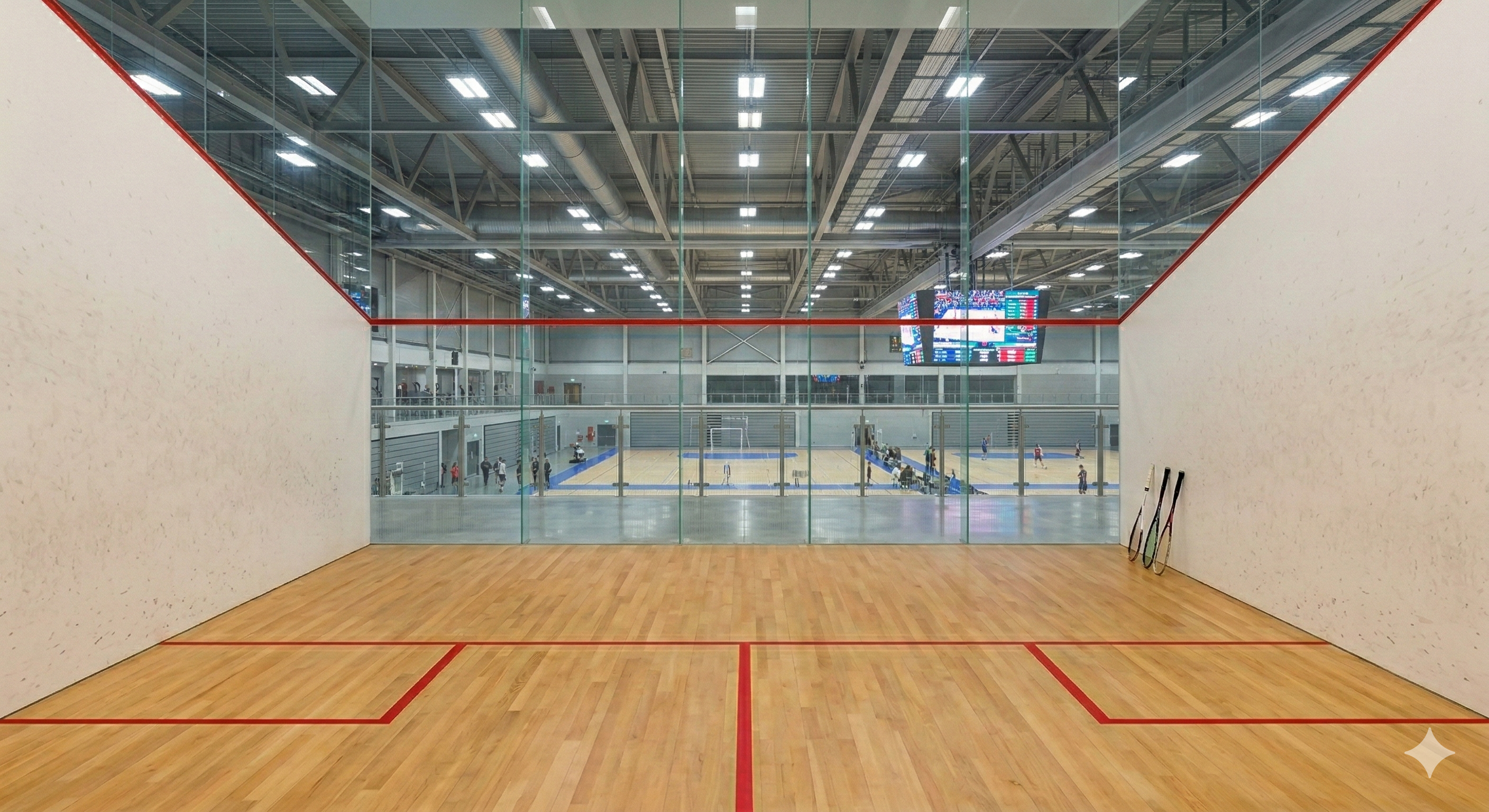
A squash court is a self-contained enclosed playing environment with very specific dimensional, wall, and floor requirements. The walls must be built to exact heights, perfectly plumb, and with a specific front wall 'tin' at the bottom. The floor must have the correct grip level for squash shoes — not too slippery, not too rough.
Squash is experiencing rapid growth in India, particularly in corporate offices, premium clubs, and residential complexes. The World Squash Federation (WSF) has detailed specifications for both glass-wall (all-glass) courts for spectator events and traditional white-wall courts for club use.
Durosport designs and builds single squash courts as well as multi-court squash academies. We handle everything from structural design of the walls to the engineered hardwood floor and the lighting system — ensuring your court meets WSF standards.
How Much Does a Squash Facility Cost in India?
| Facility Type | Approx. Cost (INR) | Timeline |
|---|---|---|
| Standard White-Wall Court (single) | ₹15 – 25 Lakhs | 8–12 weeks |
| All-Glass Competition Court (single) | ₹40 – 80 Lakhs | 12–18 weeks |
| 4-Court Squash Academy | ₹80 Lakhs – 2.5 Crore | 20–32 weeks |
⚠ Squash court construction requires specialist wall engineering and flooring. All-glass courts use tempered/toughened glass panels that significantly increase cost. Indicative India 2025–26 pricing.
What Does a Squash Build Include?
- Structural design and engineering for squash court walls
- Block/brick wall construction with plastered finish (white-wall courts)
- Tempered glass panel installation (all-glass courts)
- Solid hardwood maple floor with WSF-approved finish
- Tin and board installation (front wall specification)
- WSF line markings (service box, half court line, cut line, tin line)
- Recessed LED lighting with glare-free specification
- Door with glass panel and precision hinges
- Ventilation and climate control guidance
Dimensions & Standards
Court size9.75 m x 6.40 m (32 ft x 21 ft)
Court Line Markings
Front wall line height4.57 m (15 ft)
Service line height1.78 m (5 ft 10 in)
Back wall line height2.13 m (7 ft)
Tin height0.48 m (17 in)
Short line from back wall4.26 m (14 ft)
Service box size1.60 m (5 ft 3 in)
Recommended Buffer / Run-Off
Surfaces Used
Hardwood sports flooring
Specialized squash wall systems
Tempered glass (show courts)
Certifications & Standards
WSF
Design & Performance Notes
Squash courts demand precise wall alignment and line accuracy. Surface reflectance and lighting uniformity reduce player fatigue and eye strain.
Glass-back courts require additional structural engineering to support spectator sightlines and vibration control.
Typical Build Scope
Sub-Base Work
Top Flooring: Hardwood sports flooring, Specialized squash wall systems, Tempered glass (show courts)
Lighting
Accessories / Civil Works
Planning Framework for Squash Projects
High-performance Squash facilities are built through a sequence of design, engineering, and execution decisions. The first step is a technical feasibility review of the site: available footprint, soil behavior, water movement, utility lines, access points for equipment, and expected user load. This early assessment helps prevent downstream rework and allows the project team to make realistic budget and timeline commitments.
Next, Durosport aligns the design intent to your operating model. A school, academy, club, developer, and government body each require a different balance of performance, durability, maintenance frequency, and lifecycle cost. For Squash projects, this means selecting the right surface stack-up, defining sub-base tolerances, planning drainage and slope control, and specifying ancillary infrastructure so the facility performs consistently from day one.
Procurement and installation quality control are equally important. Material approvals, mock-up validation, layer thickness checks, and tolerance measurements at each milestone reduce technical risk. Instead of treating handover as the finish line, we define a commissioning checklist that includes gameplay validation, user safety checks, and a preventive maintenance SOP so the facility retains performance over years of use.
If you are evaluating a new build versus a resurfacing path, compare options using long-term operating cost, downtime during execution, and certification goals where applicable. This gives decision-makers a practical framework rather than choosing only on upfront capex.
Implementation Roadmap, Internal Links, and Next Steps
For most Squash projects, implementation is strongest when workstreams run in parallel: design finalization, civil preparation, material planning, and compliance documentation. Teams that sequence these streams clearly reduce delays and keep the site ready for each specialized crew. Durosport can support complete turnkey delivery or coordinate with your architect and PMC under a defined QA workflow.
To evaluate technical options in detail, start with wood sport flooring details, support-area flooring options, and indoor envelope planning. These pages help you compare systems and define specifications that match your usage pattern, climate exposure, and maintenance bandwidth.
For budget planning, use the sports facility cost guide to set a realistic range before BOQ finalization. When you are ready to convert this into a project-specific proposal, submit your site details through the free consultation form and our team will share an itemized, execution-ready recommendation.
Every project also benefits from documenting post-installation maintenance and yearly inspection checkpoints. This ensures surface integrity, player safety, and predictable performance throughout the asset lifecycle.
Frequently Asked Questions
What are the dimensions of a standard squash court?
A WSF-standard squash court is 9.75m long × 6.40m wide. The front wall height is 4.57m, back wall 2.13m, with the side wall sloping between the two heights. The out line, tin height (0.48m), and service boxes are marked precisely to WSF specifications.
What is an all-glass squash court and why is it more expensive?
An all-glass court replaces the traditional white plaster walls with fully transparent tempered glass panels, allowing spectators to watch the game from all four sides. The glass panels require precision engineering, specialist installation, and the tempered safety glass itself is significantly more expensive than brick/block construction.
What type of floor is used in squash courts?
Traditional squash courts use solid maple hardwood flooring with a semi-matte finish. The floor must be flat to within 3mm across the full court length. Engineered hardwood and specialist sports vinyl are alternatives used in warmer/humid Indian climates where solid hardwood may not perform well.
How much space do I need for a squash court?
The court itself is 9.75m × 6.40m, but you need additional space for the enclosing structure walls (typically 30–40cm on each side) and a viewing gallery behind the back wall. Total building footprint is usually 11m × 7.5m per court, plus gallery space.
Can a squash court be built inside an existing building?
Yes — squash courts are frequently built inside existing commercial buildings, offices, and club premises. We assess structural loads, ceiling height (minimum 5.64m clear is required), and ventilation requirements before designing the court to fit the available space.
Explore Related Pages
🏗️ Surface Materials
🏟️ Related Sports
Get a call from our team for a quotation
Tell us about your project and we will recommend the right surface and standards.
Request a call