
📋 In This Guide
- Standard Tennis Court Dimensions and Space Requirements
- Complete Cost Breakdown — Component by Component
- Surface Options: Acrylic vs Synthetic Clay vs Cushioned
- City-Wise Pricing: Delhi, Mumbai, Bangalore, Hyderabad & More
- ITF Certification — What It Costs and When You Need It
- Indoor vs Outdoor Tennis Courts: Price Difference
- Annual Maintenance Costs
- Budget Tiers: What You Get at Each Price Point
- Key Takeaways & Next Steps
1. Standard Tennis Court Dimensions and Space Requirements
Before getting into costs, you need to understand how much space a tennis court actually requires. The playing area itself is fixed by international rules, but the total footprint — including run-off areas — is significantly larger than most people expect.
An ITF-standard singles court measures 23.77m x 8.23m (78 ft x 27 ft). A doubles court is wider at 23.77m x 10.97m (78 ft x 36 ft). However, the total area you need includes mandatory run-off space behind each baseline and alongside each sideline. For recreational play, ITF recommends a minimum total area of 34.77m x 17.07m. For tournament-level play, you need 36.57m x 18.29m.
In square feet, this translates to roughly 6,000–6,700 sq ft of total constructed area for one court. Most builders in India plan for approximately 6,200 sq ft as a practical standard that accommodates comfortable play without excessive land use.
If you're building two or more adjacent courts, you can share side run-off areas and reduce the per-court footprint by 10–15%. A twin-court setup typically needs about 11,000 sq ft instead of 12,400 sq ft for two independent courts.
2. Complete Cost Breakdown — Component by Component
A tennis court isn't just a surface. It's a layered system — and each layer adds to the cost. Here's what goes into building a single outdoor tennis court in India in 2026:
Site Preparation and Earthwork
This includes clearing, levelling, and compacting the ground. If the site has a slope, you'll need cut-and-fill earthwork to achieve the flatness a tennis court demands. Typical cost: ₹1.5–3 lakh depending on terrain and soil type. Rocky or waterlogged sites cost significantly more.
Sub-Base and Base Construction
The sub-base is the foundation that prevents your court from cracking or settling. It typically consists of compacted stone aggregate (WBM — Wet Mix Macadam) followed by a reinforced concrete slab of 100–125mm thickness. This is the most critical structural element. A poorly built base will crack your surface within 2–3 years regardless of how good the surface material is. Typical cost: ₹4–7 lakh per court.
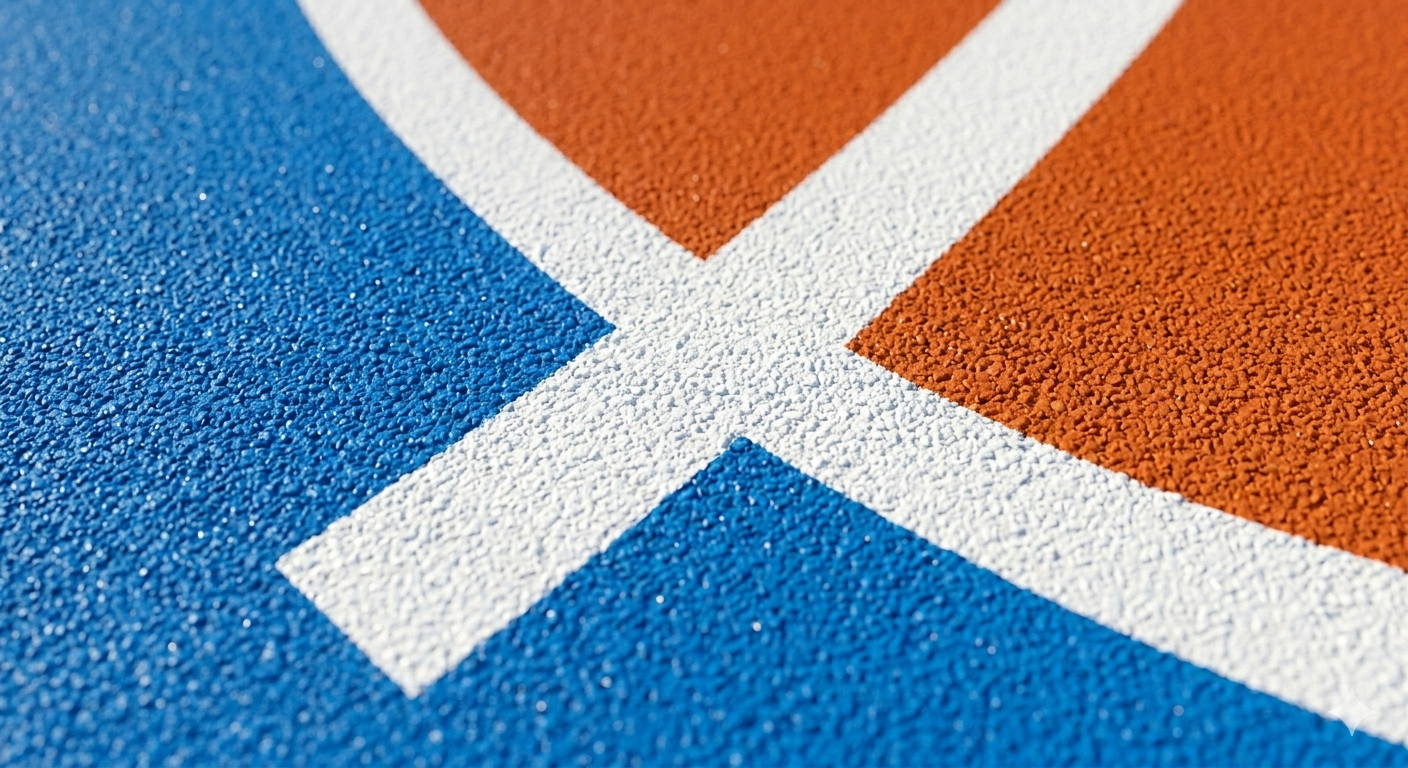
Acrylic coating being applied on a prepared concrete base — the most popular tennis court surface in India
Playing Surface
This is the coloured, playable layer applied on top of the concrete base. It's usually the line item clients focus on, but it represents only 25–35% of the total project cost. We'll compare surface options in detail in the next section. Typical cost: ₹3–8 lakh per court depending on material.
Fencing
Tennis courts require perimeter fencing — both for ball containment and security. The standard is a 10-foot chain-link fence on galvanised iron (GI) or mild steel (MS) posts, with a windscreen mesh for outdoor courts. Typical cost: ₹2–4 lakh per court, depending on height and material quality.
Court Lighting
If you plan to use the court after sunset — which is essential in India given the daytime heat — you'll need floodlighting. ITF recommends a minimum of 300 lux for recreational play and 500 lux for club-level competition. Most installations use 4–8 LED floodlights on 6–8 metre poles. Typical cost: ₹2.5–5 lakh per court for LED systems.
Net Post System and Accessories
A regulation net post system (round or square posts, centre strap, net) costs ₹25,000–₹60,000 depending on the brand. Add ₹10,000–15,000 for a basic scoreboard, and ₹5,000–10,000 for a courtside bench.
Drainage
Outdoor courts need proper drainage to prevent water pooling during monsoons. A perimeter channel drain with catchment sump typically costs ₹50,000–₹1.5 lakh. Courts with acrylic surfaces need a 1% slope built into the concrete base to encourage runoff.
For a standard acrylic-surface outdoor tennis court with fencing and lighting, expect a total project cost of ₹14–25 lakh in most Indian cities in 2026. Premium cushioned surfaces or ITF-certified installations can push this to ₹28–40 lakh.
3. Surface Options: Acrylic vs Synthetic Clay vs Cushioned
The playing surface is the most visible and tactile part of the court. In India, three surface types dominate the tennis court market. Each plays differently, costs differently, and is suited to different contexts.
Acrylic Hard Court Most popular in India — US Open / Australian Open style
Acrylic is the workhorse of Indian tennis courts. Multiple layers of acrylic resin paint are applied over a concrete base, creating a durable, consistent surface. The texture can be adjusted — more sand for a slower game, less for faster play. Brands like Plexicushion, DecoTurf, and Laykold are well-known internationally, while Indian manufacturers offer competitive alternatives at lower price points.
- Lowest ongoing maintenance cost
- Excellent UV and weather resistance
- Consistent ball bounce
- ITF certifiable
- Wide colour and speed options
- Hard on joints (no cushioning in basic version)
- Surface cracks if base is poorly built
- Can be slippery when wet
- Gets hot in Indian summers
Synthetic Clay French Open feel — slower, higher bounce
Synthetic clay replicates the playing characteristics of traditional red clay without the intensive daily maintenance. Modern systems use a polymer-bound crushed brick layer or artificial turf with clay-coloured sand infill. The ball bounces higher and slower, which suits baseline players and is easier on joints. It's growing in popularity across Indian tennis academies.
- Easier on joints — lower impact
- Excellent for coaching and academy use
- Slower game suits Indian heat (longer rallies)
- Natural slide possible
- Higher maintenance than acrylic
- Surface material needs periodic replenishment
- Fewer Indian suppliers
- Dries out quickly in arid climates
Cushioned court systems use a polyurethane or rubber underlayer beneath the acrylic topcoat for joint protection
Cushioned Acrylic Premium — best joint protection on a hard court
A cushioned acrylic court adds 1–3 layers of rubber granule-bound cushioning beneath the standard acrylic topcoat. This significantly reduces impact on players' knees, ankles, and back — making it the preferred choice for competitive training academies, senior players, and high-usage clubs. The Australian Open uses a cushioned acrylic system (GreenSet Plexicushion).
- Significantly reduced joint impact
- Professional-grade playing experience
- Longer lifespan than basic acrylic
- ITF certified for competitions
- 40–80% more expensive than basic acrylic
- Requires experienced applicators
- Longer installation time
- Cushion layer can degrade in waterlogged conditions
4. City-Wise Pricing: Delhi, Mumbai, Bangalore, Hyderabad & More
Construction costs in India vary significantly by city due to differences in labour rates, material transport costs, land preparation complexity, and local contractor availability. Here's what you can expect for a complete single outdoor tennis court (acrylic surface, fencing, lighting) in major cities:
| City | Basic Acrylic Court | Cushioned Acrylic | Synthetic Clay | Key Factor |
|---|---|---|---|---|
| Delhi NCR | ₹16–22 lakh | ₹26–36 lakh | ₹20–30 lakh | High labour costs, good contractor supply |
| Mumbai | ₹18–25 lakh | ₹28–40 lakh | ₹22–32 lakh | Highest costs — space constraints, logistics |
| Bangalore | ₹15–21 lakh | ₹24–34 lakh | ₹19–28 lakh | Growing market, moderate rates |
| Hyderabad | ₹14–20 lakh | ₹22–32 lakh | ₹18–26 lakh | Competitive pricing, strong infra ecosystem |
| Chennai | ₹15–22 lakh | ₹24–34 lakh | ₹19–28 lakh | Coastal humidity — drainage critical |
| Pune | ₹14–19 lakh | ₹22–30 lakh | ₹17–25 lakh | Lower rates than Mumbai, growing demand |
| Kolkata | ₹13–18 lakh | ₹20–28 lakh | ₹16–24 lakh | Lower labour costs, fewer specialist contractors |
| Tier 2 Cities | ₹12–17 lakh | ₹20–28 lakh | ₹15–22 lakh | Transport costs offset lower labour rates |
Note: These ranges include civil works, surface, fencing, lighting, and basic accessories. Land cost, landscaping, clubhouse, and seating are not included. Actual quotes will vary based on site conditions and specific requirements.
5. ITF Certification — What It Costs and When You Need It
The International Tennis Federation (ITF) classifies court surfaces on a pace scale from 1 (slow) to 5 (fast) and certifies products that meet performance standards for ball bounce, surface friction, and colour reflectance. But do you actually need ITF certification?
You need ITF certification if: your court will host AITA-sanctioned tournaments, state or national-level competitions, or you're building for a sports authority or government body that specifies it in the tender.
You don't need ITF certification if: the court is for recreational use, a housing society, a school, or a private academy that doesn't host sanctioned events. In these cases, using an ITF-classified (but not individually certified) surface material is perfectly adequate and saves significant cost.
The cost of ITF certification itself involves using an approved surface product (which adds ₹15–30 per sq ft over generic alternatives), plus a testing fee of approximately ₹1.5–3 lakh for the on-site assessment by an ITF-approved testing agency. Total premium: roughly ₹2.5–5 lakh over a standard build.
6. Indoor vs Outdoor Tennis Courts: Price Difference
Building a tennis court indoors changes the equation substantially. You gain weather independence — no rain delays, no heat issues, no UV degradation — but you add the cost of a structure large enough to enclose the court with adequate ceiling height.
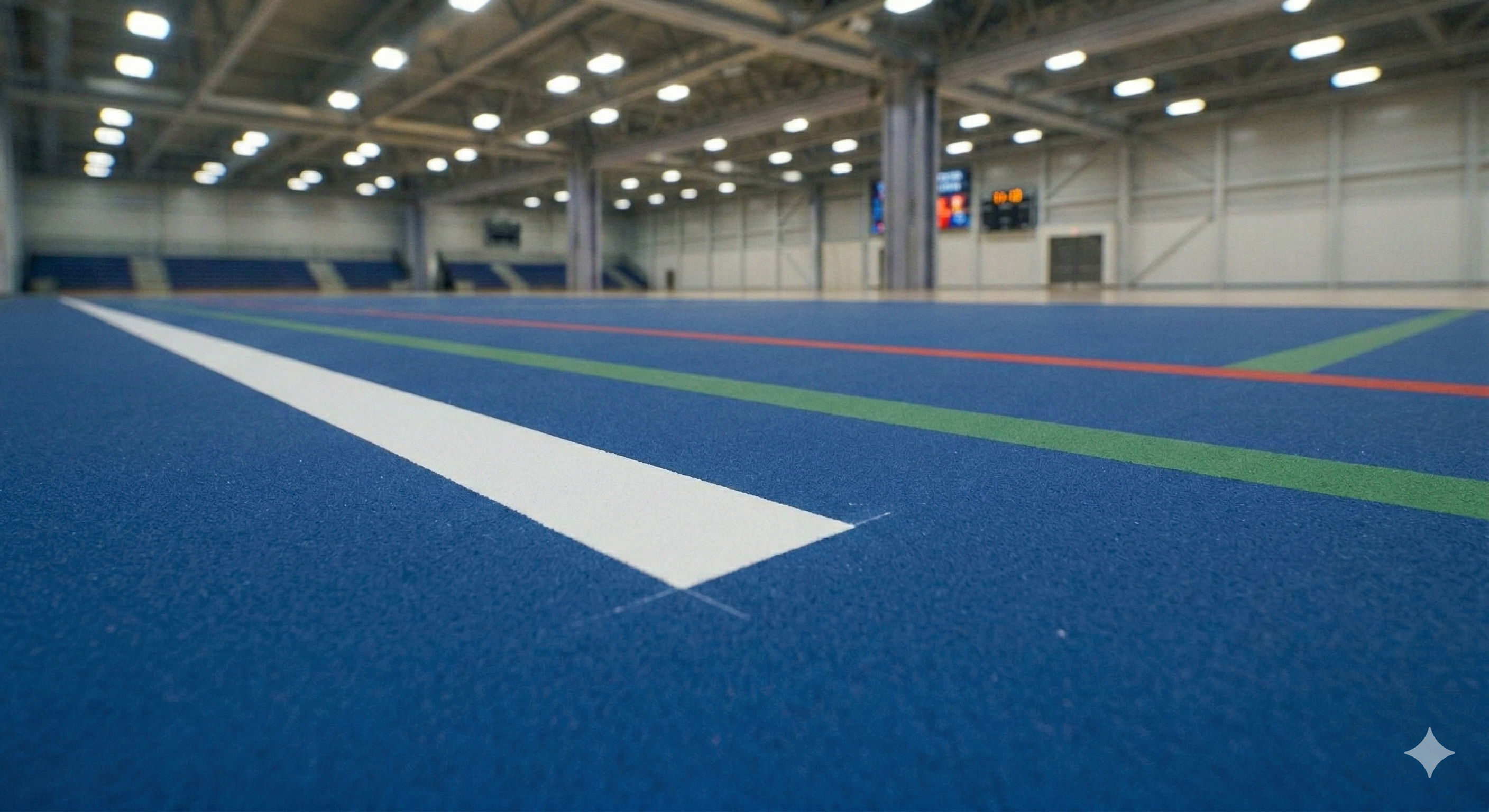
Indoor courts eliminate weather dependency but require significant structural investment
The ITF recommends a minimum ceiling height of 9.14m (30 ft) for recreational indoor courts and 12.19m (40 ft) for competition venues. A pre-engineered building (PEB) structure to enclose a single tennis court typically costs ₹20–40 lakh, depending on the span, cladding material, and ventilation systems.
Add to this the playing surface (which can be PVC vinyl, hardwood, or acrylic — all viable indoors), lighting (which is typically more sophisticated for indoor courts), and HVAC or ventilation, and the total cost for an indoor tennis court in India ranges from ₹45–80 lakh for a single court. Premium facilities with air conditioning, spectator seating, and professional-grade lighting can cross ₹1 crore.
An outdoor acrylic tennis court costs ₹14–25 lakh. An indoor court with a PEB structure costs ₹45–80 lakh. The indoor premium is roughly 3x, but you gain year-round usability and significantly longer surface life due to no UV or rain exposure.
7. Annual Maintenance Costs
A common mistake in budgeting is focusing only on construction cost and ignoring the ongoing maintenance commitment. Here's what to expect annually for each surface type:
Acrylic Courts: The lowest-maintenance option. Annual costs include pressure washing (₹5,000–10,000), minor crack repairs if any (₹5,000–15,000), and line repainting if needed (₹10,000–20,000). A full recoat every 5–8 years costs ₹1.5–3 lakh. Effective annual cost: ₹15,000–40,000.
Synthetic Clay: Requires regular brushing (weekly), periodic top-up of the clay material (₹30,000–60,000 per year), and attention to drainage channels. Annual cost: ₹40,000–80,000.
Cushioned Acrylic: Similar to standard acrylic for routine maintenance but the cushion layer inspection adds a small cost. Annual cost: ₹20,000–45,000. Recoat cost is higher at ₹2–4 lakh every 6–8 years due to the cushion system.
Lighting and Fencing: Budget ₹10,000–20,000 annually for LED maintenance, bulb replacement, and fence repairs. Net replacement is needed every 2–3 years (₹8,000–15,000).
8. Budget Tiers: What You Get at Each Price Point
Suitable for housing societies, schools, and recreational use. Gets the job done without premium finishes.
- Standard concrete base with basic reinforcement
- Indian-manufactured acrylic surface (5–7 coats)
- GI chain-link fencing (10 ft)
- 4 LED floodlights on steel poles
- Basic net post system and accessories
- Perimeter channel drainage
Built for regular, intensive use. Better base, better surface, better lighting — designed to last 10+ years with minimal issues.
- Engineered sub-base with quality WBM and M25+ concrete
- Premium acrylic or cushioned surface (8–10 coats)
- Powder-coated MS or aluminium fencing with windscreen
- 6–8 LED floodlights with proper lux distribution (400+ lux)
- Professional-grade net posts (round aluminium or square steel)
- Integrated drainage with slope engineering
Meets ITF certification requirements. Suitable for AITA-sanctioned events and professional training centres.
- Precision-engineered base with laser levelling
- ITF-certified cushioned acrylic or premium synthetic clay
- Custom colour scheme with professional line marking
- Competition-grade LED lighting (500+ lux, anti-glare)
- Umpire chair, scoreboard, and player benches
- ITF on-site testing and certification
9. Key Takeaways & Next Steps
Surface choice drives playing experience. Acrylic is the most practical and cost-effective for most Indian installations. Synthetic clay is excellent for academies focused on player development. Cushioned acrylic is the gold standard for competitive use and long-term joint health.
The base matters more than the surface. A ₹5 lakh surface on a ₹2 lakh base will fail faster than a ₹3 lakh surface on a ₹5 lakh base. Never cut corners on civil works — this is where 80% of tennis court problems originate.
Lighting is not optional in India. Given that peak temperatures in most Indian cities make daytime play uncomfortable for 6–8 months of the year, evening play under floodlights is when most courts see maximum usage. Budget for lighting from day one.
Location significantly affects cost. Metro cities command a 20–40% premium over tier-2 cities, primarily due to labour and logistics costs. However, metro cities also have more experienced contractors, which can reduce the risk of construction defects.
Plan for maintenance from the start. An annual maintenance budget of ₹30,000–80,000 (depending on surface type) keeps your court performing well for 10–15 years. Neglect it, and you'll need a full resurface in 5–6 years — costing far more than the maintenance would have.
Ready to Build Your Tennis Court?
Our team has built tennis courts for academies, clubs, schools, and housing societies across India. Share your requirements and we'll provide a detailed, no-obligation estimate specific to your location and needs.