
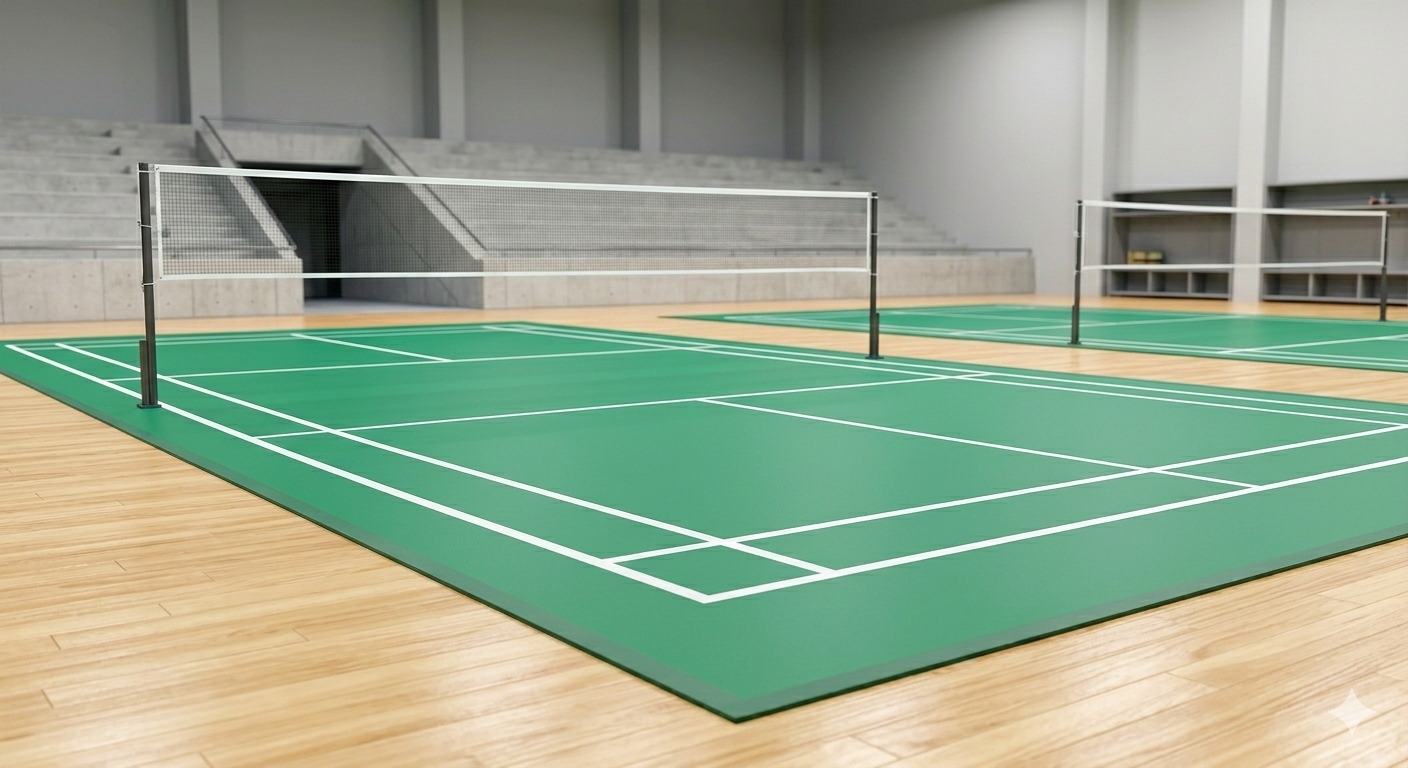
Planning to build a badminton court? Whether it's a single court for your society, a 4-court academy, or a commercial indoor badminton facility, this guide gives you real INR pricing for 2026 — broken down by flooring type, city, and scope of work. No vague ranges. Just honest numbers.
The cost of building a badminton court in India varies significantly — a basic PVC vinyl court for a housing society comes in at under ₹5 lakhs, while a BWF-certified PU sprung floor setup for a professional academy can cross ₹20 lakhs per court. Understanding why requires knowing the five main cost drivers.
The first and biggest driver is the flooring system. This is typically 50–65% of the total project cost. PVC vinyl on a concrete base costs less than half of what a PU sprung floor system does, and both are well below the cost of a professional maple hardwood floor. Getting this decision right means understanding your usage pattern — recreational, coaching, or competition — and not over-specifying or under-specifying for your needs.
The second driver is sub-base condition. If you're building on an existing flat concrete floor in good condition, your sub-base cost is near zero. If you need a new concrete slab, levelling, waterproofing, or base preparation, add ₹50,000–₹2 lakhs per court depending on size and condition. Outdoor-to-indoor conversion projects often involve the most sub-base work.
The third driver is allied works: lighting, net posts, ceiling height, HVAC (air handling for large facilities), and boundary line markings. A single court with basic flood lighting adds ₹80,000–₹1.5 lakhs on top of the flooring cost. A full 6-court hall with LED sports lighting, false ceiling, and ventilation can add ₹15–₹40 lakhs in allied works alone.
Fourth is location. Labour and logistics costs vary by city. Mumbai and Delhi are roughly 10–15% more expensive than Hyderabad or Ahmedabad for the same spec. Tier 2 cities like Coimbatore, Nagpur, or Bhubaneswar are typically 8–12% cheaper than the major metros.
Fifth is certification and testing. If you need a BWF-approved surface for official competitions, the flooring itself must meet specific shock absorption and ball rebound standards. Certified flooring products cost 15–25% more than equivalent non-certified variants, but for academies and competition venues, the certification is non-negotiable.
A standard single badminton court (PVC vinyl, basic LED lighting, net post) in most Indian cities costs ₹3.5 – ₹7 lakhs all-in. A multi-court academy (4 courts, PU sprung floor, professional lighting) ranges from ₹35 – ₹65 lakhs.
Before pricing anything, you need to know how much space a badminton court actually requires. The Badminton World Federation (BWF) specifies a playing area of 13.4 m × 6.1 m for doubles. But that's the playing court only — the full facility requires more.
For a single court, you need a minimum clear area of approximately 15 m × 8 m to allow for the 0.8–1 m run-off around all four sides. Ceiling height matters too: the BWF minimum is 9 m, though recreational facilities often get by with 7.5–8 m for non-competitive use. Below 7 m, smash trajectories are compromised and the sport suffers.
| Configuration | Playing Court Area | Min. Hall Size (with run-off) | Min. Ceiling Height |
|---|---|---|---|
| Single Court | 13.4 m × 6.1 m | ~15 m × 8 m | 7.5 m (recreational) / 9 m (BWF) |
| 2 Courts (side-by-side) | 13.4 m × 13.4 m | ~15 m × 16 m | 9 m recommended |
| 4 Courts (standard academy) | 13.4 m × 26.8 m | ~15 m × 30 m | 9 m+ |
| 6 Courts (commercial hall) | 13.4 m × 40 m | ~15 m × 44 m | 9–11 m |
For schools and housing societies working with tighter spaces, a reduced run-off of 0.5 m is acceptable for recreational play. But academies and competition venues should always target the full BWF run-off specification — getting athletes used to the correct court geometry matters for training quality.
The flooring choice defines the playing experience, maintenance requirements, injury risk, and a large chunk of your budget. There are three main categories in the Indian market in 2026.
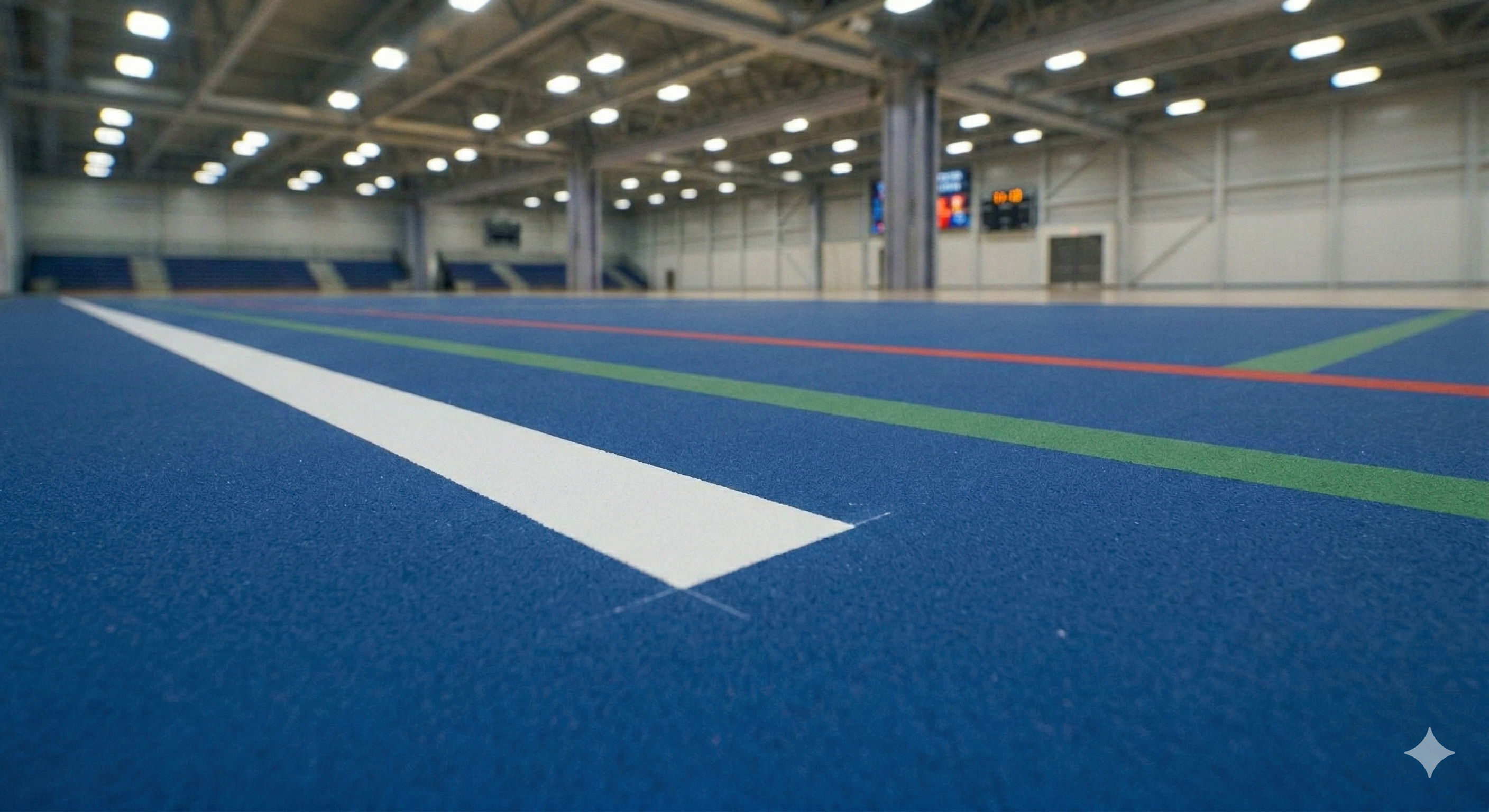
PU sprung floor systems deliver professional shock absorption for academy and competition use
PVC vinyl is the most common badminton flooring in India, used in housing societies, schools, and recreational academies. It's a roll-laid flooring system — typically 4–6 mm thick — installed directly over a flat concrete base. Non-cushion PVC is the entry-level option; cushion PVC has a foam backing that provides basic shock absorption at a modest premium.
A PU (polyurethane) sprung floor is a multi-layer system: a rubber shock pad base, an intermediate layer (often plywood), and a top PVC or hardwood surface. The "spring" in the sub-structure provides real shock absorption — reducing the joint impact on players significantly compared to a hard surface. This is the standard flooring for serious academies, state-level competition venues, and Khelo India facilities.
Maple hardwood is the gold standard for badminton at the international level. It provides an excellent playing experience, looks premium, and lasts decades with proper care. However, in India's climate — especially in coastal cities with high humidity — hardwood demands rigorous climate control (HVAC) to prevent warping and expansion. The cost is also 3–5× that of PVC vinyl. Hardwood is practical mainly for large, well-equipped indoor sports halls with year-round climate control.
Here's how the numbers actually stack up in 2026 for the most common badminton court configurations in India. These figures include the flooring supply and installation, basic line marking, and net post infrastructure. They exclude civil works, lighting, HVAC, and fencing.
A finished 4-court PVC vinyl badminton facility — the most common setup for recreational academies in India
The entry-level option for a housing society, school, or small coaching setup. Includes PVC flooring (4–5 mm), adhesive installation, badminton court line markings in three colours, and net post sockets. Does not include net, lighting, or sub-base prep.
A step up in comfort and shock absorption. Cushion PVC has a closed-cell foam backing (typically 3–5 mm foam + 4 mm wear layer). Suitable for coaching academies with moderate weekly usage (100–200 player-hours/week). Includes the same ancillary items as above.
Professional-grade setup with a multi-layer sprung sub-structure. Typical layers: rubber shock pad + plywood panel + PVC or hardwood top surface. Suitable for high-intensity academies, state competitions, and Khelo India compliant facilities. Includes all items above.
The most popular commercial badminton setup in India — typically in a hall of 15 m × 30 m or larger. Four courts with full colour line marking. Economy of scale applies; per-court cost comes down at 4+ courts versus a single court project.
High-performance setup for serious academies and competition venues. Includes full sprung system across 400+ sqm. If BWF approval is required, add ₹2–₹5 lakhs for certified surface variant and testing documentation.
📌 Note on GST: All above figures are indicative ex-GST. Add 18% GST on materials and 18% on labour/services for total invoice value. Some turnkey contractors quote inclusive of GST — always clarify before comparing quotes.
The flooring is just one part of the project. A complete badminton facility also needs proper lighting, at minimum, and often boundary fencing or curtains, a false ceiling or acoustic panels, and entrance infrastructure. Here's a realistic breakdown of allied costs.
Badminton is a fast sport with a small shuttlecock — poor lighting is a safety issue, not just a comfort issue. The Badminton Association of India (BAI) and BWF specify a minimum of 500 lux at court level for training, and 750–1,500 lux for competition. LED sports lights are now standard — they're more energy efficient, last longer, and provide better colour rendering than older metal halide fittings.
| Configuration | Lux Level | Approx. Cost (LED) | Use Case |
|---|---|---|---|
| Single Court Basic | 300–400 lux | ₹60,000 – ₹1.2 lakhs | Recreational / society use |
| Single Court Training | 500–600 lux | ₹1 – ₹1.8 lakhs | Coaching academy |
| 4 Courts Training | 500 lux | ₹3.5 – ₹6 lakhs | Standard academy |
| 4 Courts Competition | 750–1,000 lux | ₹7 – ₹14 lakhs | District/state competition |
| 6 Courts Professional | 1,000–1,500 lux | ₹15 – ₹28 lakhs | National/international events |
Boundary curtains (also called court dividers or backdrop curtains) serve two purposes: they prevent shuttlecocks from straying between courts, and they create a dark backdrop for better shuttlecock visibility. For a 4-court hall, expect to spend ₹2–₹6 lakhs on curtain systems depending on material (PVC mesh vs canvas), height (6–10 m), and motorisation (manual pull vs automated roll).
Standard aluminium telescopic net posts (a pair) cost ₹8,000–₹25,000 depending on quality. Tournament-grade posts with tension wheels cost ₹20,000–₹45,000 per pair. Nets themselves are ₹1,500–₹8,000 each. Budget ₹12,000–₹50,000 per court for post + net depending on the quality tier you're targeting.
A false ceiling (to achieve the required clear height), structural modifications for lighting mounting, or pre-engineered steel structure for a new hall adds ₹15–₹80 lakhs depending on the scale. New hall construction including pre-engineered building (PEB) structure for a 4-court facility is typically ₹40–₹90 lakhs for structure and roofing alone — before flooring and allied works.
Labour costs, logistics, and local contractor availability all affect the final project cost. The table below shows approximate adjustment factors versus a Hyderabad/Pune baseline for a typical 4-court PVC vinyl project.
| City / Region | Cost vs Baseline | Key Factors |
|---|---|---|
| Mumbai | +12 – +18% | High labour costs, logistics premium, urban access |
| Delhi / NCR | +8 – +15% | Strong contractor competition but higher labour rates |
| Bengaluru | +5 – +12% | Good local contractors, materials widely available |
| Chennai | +3 – +8% | Good port access for imports, moderate labour |
| Hyderabad / Pune | Baseline | Competitive contractor market, good logistics |
| Ahmedabad | –3 – –8% | Lower labour costs, strong industrial base |
| Tier 2 (Nagpur, Coimbatore, etc.) | –5 – –12% | Lower labour, fewer specialist contractors |
| Northeast India | +15 – +25% | Higher logistics, limited local contractors, material freight |
In Tier 2 and Tier 3 cities, lower labour costs can be offset by higher logistics costs if materials need to be shipped from a metro. Always get a project-specific quote — regional averages can be misleading for specific sites.
Get a site-specific quote from Durosport — we've built 200+ sports facilities across India and can give you a realistic cost estimate based on your exact location, floor condition, and requirements.