
In This Article
- Basketball Court Sizes & Dimensions
- Surface Options & Their Costs
- Full Cost Breakdown (Court + Infrastructure)
- Indoor vs Outdoor: What Changes?
- City-Wise Price Variations
- FIBA Compliance: What It Actually Requires
- Hidden Costs Most Builders Don't Tell You About
- Typical Timeline & Project Phases
- ROI: Is a Basketball Court a Good Investment?
1. Basketball Court Sizes & Dimensions
Before you can price a basketball court, you need to know the size you're building. This sounds obvious, but it's where most budgets go wrong. The court itself is one dimension — the total area you need (including run-off zones, spectator space, and structural clearances) is always larger.
A regulation FIBA court measures 28m × 15m (420 sq. m.), but the total playing area with run-offs is typically 32m × 19m (608 sq. m.). For school or recreational courts, a half-court (15m × 14m) or a slightly reduced full court (26m × 14m) is more common and far more budget-friendly.
| Court Type | Dimensions | Total Area (with run-off) |
|---|---|---|
| FIBA Full Court | 28m × 15m | ~608 sq. m. |
| Standard Full Court | 26m × 14m | ~520 sq. m. |
| Half Court (Recreational) | 15m × 14m | ~260 sq. m. |
| 3×3 FIBA Court | 15m × 11m | ~210 sq. m. |
A 3×3 basketball court is gaining enormous popularity in India — especially after India's national 3×3 programme picked up pace. It requires roughly one-third the area and budget of a full court, making it ideal for commercial sports centres and school campuses.
2. Surface Options & Their Costs
The playing surface is the single biggest variable in your basketball court budget. In India, four surface types dominate the market for basketball. Each has a different cost profile, performance characteristic, and maintenance requirement.
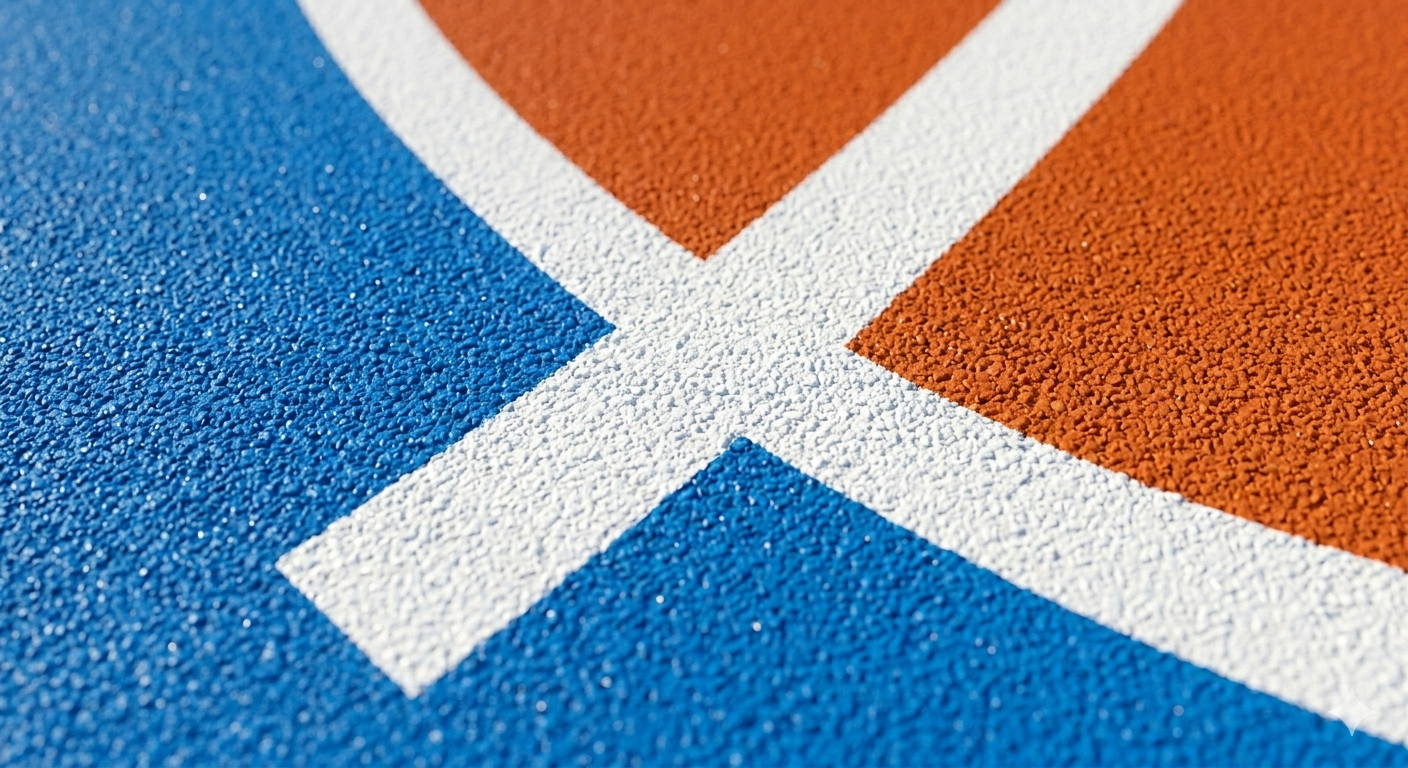
Acrylic hard courts are the most popular choice for outdoor basketball in India due to their durability and all-weather performance.
Acrylic Hard Court Most Popular for Outdoor Basketball
Acrylic is by far the most widely used basketball surface in India — and for good reason. It performs well outdoors, handles monsoon drainage decently (with proper sub-base), requires minimal maintenance, and delivers consistent ball bounce. This is what you'll find on most school, club, and municipal courts across the country.
Polyurethane (PU) Premium Indoor Surface
PU flooring is the gold standard for indoor basketball courts — used in professional arenas, state-level competitions, and high-end academies. It offers superior shock absorption, excellent traction, and is kinder on players' joints compared to acrylic. The trade-off is cost — PU is roughly 2–3× the price of acrylic, and it needs a flat, moisture-free concrete base to perform well.
PP Interlocking Tiles Quick-Install Modular Surface
Polypropylene (PP) interlocking tiles have become increasingly popular in India over the last three years, especially for 3×3 courts and multi-sport facilities. They snap together without adhesive, can be installed over any flat surface (including existing concrete), and are easy to replace section by section. Ball bounce is slightly different from acrylic — a bit more "muted" — but for recreational and school use, they're an excellent option.
Rubber Flooring (SBR/EPDM) Shock-Absorbent & Durable
Rubber surfaces — either SBR granules or EPDM — are sometimes used for outdoor basketball courts in India, especially in multi-sport complexes where the same surface serves basketball, volleyball, and general fitness. They offer excellent shock absorption and are very forgiving on joints. However, ball bounce characteristics are different from traditional hard courts, so competitive players often prefer acrylic or PU.
3. Full Cost Breakdown (Court + Infrastructure)
The surface is just one piece of the puzzle. A complete basketball court project includes civil work, sub-base preparation, fencing, lighting, equipment, and line marking. Here's how the total cost typically breaks down for a standard full-size outdoor acrylic court in India.
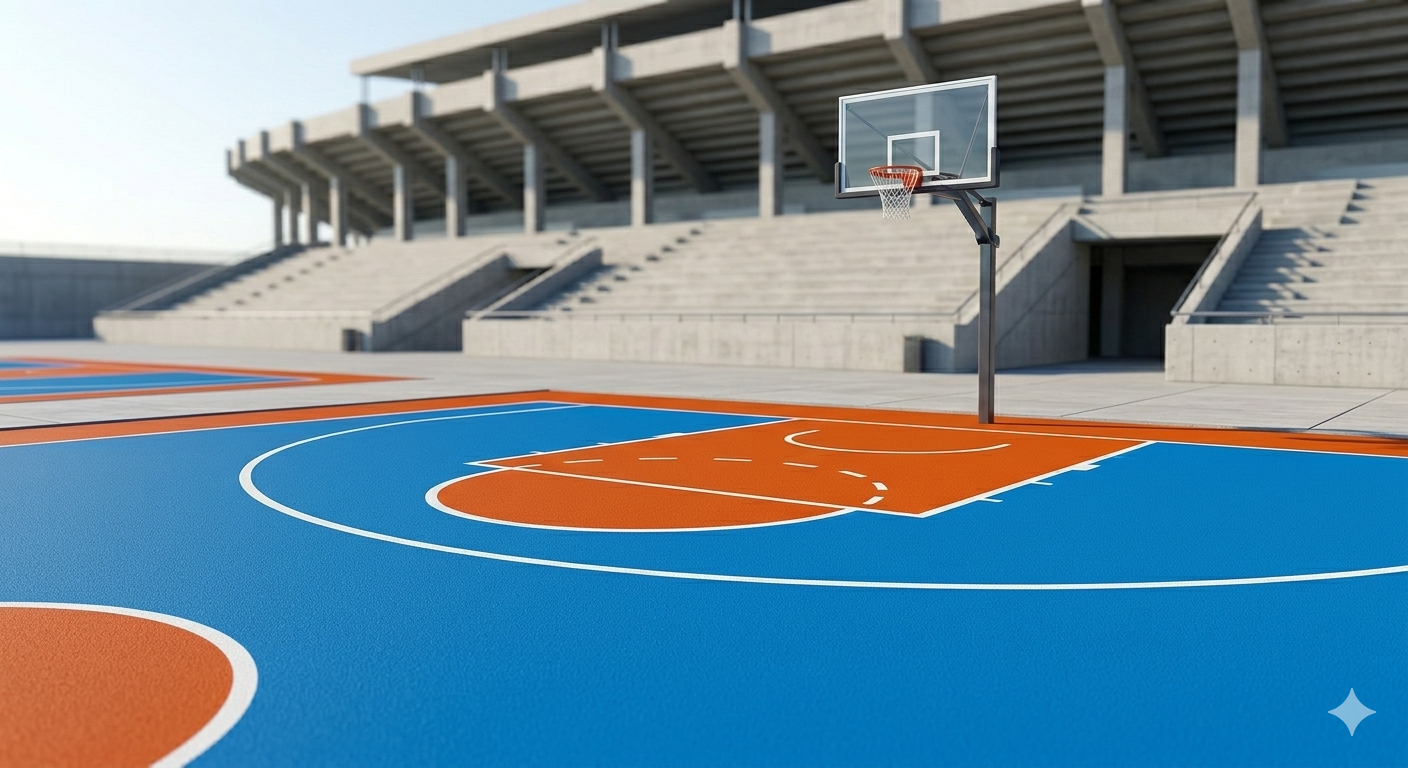
A complete basketball court includes sub-base, surface, line marking, hoops, fencing, and LED lighting.
| Component | Estimated Cost (Full Court) | Notes |
|---|---|---|
| Site preparation & earthwork | ₹1.5 – ₹3.5 lakh | Depends on soil condition, levelling needed |
| Concrete sub-base (6" thick) | ₹4 – ₹7 lakh | M25 grade concrete, reinforced, with slope for drainage |
| Acrylic surface (7-layer system) | ₹3.5 – ₹6 lakh | Includes resurfacer, filler, cushion, and colour coats |
| Line marking & logos | ₹25,000 – ₹60,000 | FIBA-spec lines; multi-sport markings cost more |
| Basketball hoops & backboards (pair) | ₹80,000 – ₹3.5 lakh | Fixed in-ground hoops; breakaway rims at higher end |
| Perimeter fencing (chain-link, 3m high) | ₹1.5 – ₹3 lakh | Galvanised steel; powder-coated costs ~20% more |
| LED floodlights (4–6 poles) | ₹1.5 – ₹4 lakh | 200–300 lux for recreational; 500+ lux for competition |
| Drainage system | ₹50,000 – ₹1.5 lakh | Perimeter channel drains; critical in high-rainfall zones |
| Total (Outdoor Acrylic Full Court) | ₹14 – ₹28 lakh | Varies by city, site condition, and spec level |
For a half-court or 3×3 court, you can expect to spend roughly 40–50% of the full-court budget. A well-built outdoor acrylic half-court typically costs ₹6 – ₹13 lakh all-in, making it a very attractive proposition for residential societies and school campuses.
4. Indoor vs Outdoor: What Changes?
Building an indoor basketball court is a fundamentally different project from an outdoor one — and significantly more expensive. The court surface itself may actually cost less (because you don't need the same weather-resistance), but the building structure, HVAC, and higher lighting requirements add up fast.
For an indoor facility, you're looking at additional costs for a pre-engineered building (PEB) or RCC structure with minimum 8m clear height, HVAC or industrial ventilation, competition-grade lighting (500+ lux), and acoustic treatment. The PEB structure alone can cost ₹15–30 lakh depending on the span and location.
A complete indoor basketball court with PU flooring and PEB structure typically costs ₹35–65 lakh for a single full-size court. Multi-court facilities in metro cities can cross ₹1 crore easily when you factor in changing rooms, spectator seating, and scoreboard systems.
5. City-Wise Price Variations
Construction costs in India vary significantly by city — driven by differences in labour rates, material transport costs, land preparation challenges, and local contractor availability. Here's a realistic snapshot of what you can expect for a standard outdoor acrylic full court across major cities.
| City | Estimated Total Cost | Key Factor |
|---|---|---|
| Delhi NCR | ₹18 – ₹28 lakh | High labour costs, excellent contractor availability |
| Mumbai | ₹20 – ₹30 lakh | Highest land prep costs; rocky terrain in many areas |
| Bangalore | ₹16 – ₹26 lakh | Strong demand; good material supply chain |
| Hyderabad | ₹14 – ₹24 lakh | Competitive rates; growing sports infrastructure market |
| Chennai | ₹15 – ₹25 lakh | Monsoon drainage adds cost; skilled labour available |
| Pune | ₹15 – ₹24 lakh | Good value; proximity to Mumbai suppliers |
| Tier-2 Cities | ₹12 – ₹20 lakh | Lower labour costs; material transport may add ₹1–2 lakh |
Acrylic courts can be line-marked for multiple sports — basketball, tennis, and volleyball on one surface.
6. FIBA Compliance: What It Actually Requires
If you're building for competitive basketball — state-level tournaments, university championships, or anything that needs official sanction — you'll need to meet FIBA (International Basketball Federation) standards. Here's what that actually means in practical terms.
The court must be exactly 28m × 15m with a minimum 2m run-off on all sides. The playing surface needs to provide consistent ball rebound — FIBA doesn't mandate a specific material, but it does require a certified surface that meets their performance criteria. You'll need a minimum clear ceiling height of 7m (8m+ recommended), competition-grade lighting at 500 lux minimum on the playing surface, and a certified electronic scoreboard and shot clock system.
In practice, FIBA compliance adds roughly 15–25% to your base court cost, primarily through higher-spec surface systems, better lighting, and the mandatory equipment. For a full-size FIBA-compliant outdoor court, expect ₹20–35 lakh. For an indoor FIBA court, the budget typically starts at ₹50 lakh and can go well beyond ₹1 crore depending on the venue.
7. Hidden Costs Most Builders Don't Tell You About
Every basketball court project has costs that don't show up in the initial quotation. Being aware of these upfront can save you from budget overruns and unpleasant surprises mid-construction.
Soil Testing & Geotechnical Survey
If your site has black cotton soil (common in Maharashtra, Karnataka, and Telangana), you'll need additional stabilisation work — potentially ₹1–3 lakh extra. A proper soil test costs ₹8,000–15,000 and is absolutely worth it before you pour concrete.
Electrical Connection & Transformer
LED floodlighting for a full court draws 3–6 kW. If your site doesn't have adequate electrical capacity, you may need a dedicated connection or even a small transformer — ₹50,000 to ₹2 lakh depending on the DISCOM and your location.
Approach Road & Access
Heavy vehicles need to deliver concrete, steel, and surface materials to your site. If access is poor, you'll pay a premium for smaller vehicle loads or manual material handling — sometimes adding ₹50,000–1.5 lakh to the project.
Waterproofing (Indoor Courts)
For indoor PU courts, moisture rising through the concrete slab is the number one enemy. A proper vapour barrier and waterproofing membrane costs ₹40–60 per sq. ft. but prevents catastrophic surface failure within a few years.
8. Typical Timeline & Project Phases
A standard outdoor basketball court takes 4–8 weeks from site preparation to handover, depending on weather and site conditions. Here's the typical sequence:
Week 1–2: Site clearing, earthwork, and levelling. If significant cut-and-fill is needed, this can extend to 3 weeks. Soil stabilisation (if required) happens here.
Week 2–3: Sub-base construction — laying the aggregate base, compaction, and pouring the concrete slab. The slab needs a minimum 14-day curing period before surface work begins.
Week 4–5: Surface application. For acrylic, this involves multiple coats — resurfacer, filler, cushion layers, colour coats, and finally line marking. Each coat needs 12–24 hours of drying time, and rain delays are common during monsoon season.
Week 5–7: Ancillary work — hoop installation, fencing, lighting, and drainage. These can run in parallel with the later surface coats.
Week 7–8: Final inspection, punch-list items, and handover. A good contractor will do a ball-bounce test and surface evenness check before signing off.
The best time to build an outdoor basketball court in most of India is October to March — after the monsoon and before peak summer. Avoid starting concrete work during heavy rains, and factor in at least 2 weeks of weather contingency in your schedule.
9. ROI: Is a Basketball Court a Good Investment?
If you're building a basketball court for a commercial sports facility, the ROI question matters. Here's the realistic picture based on what we see across our projects in India.
A well-managed outdoor basketball court in a metro or Tier-1 city can generate ₹1,500–3,000 per hour in booking revenue during peak hours (evenings and weekends). With 4–5 bookable hours per weekday and 8–10 hours on weekends, that translates to roughly ₹1.5–3 lakh per month in gross revenue.
Against a total build cost of ₹15–25 lakh, most operators break even in 12–18 months — assuming they're in a location with decent footfall and a basketball-playing community. Coaching programmes and corporate bookings can significantly accelerate the payback period.
Adding 3×3 courts alongside a full court is a smart revenue strategy — 3×3 is easier to fill, appeals to casual players, and the per-square-foot revenue is actually higher than a full court because games are shorter and turnover is faster.
Schools and residential societies should think of the court as an amenity investment rather than a revenue centre. A well-built basketball court adds genuine value to a campus and is one of the most heavily used facilities in any school or housing complex.