
📋 In This Guide
- Why School Sports Infrastructure Matters in India
- Planning Your School Sports Facility: Key Questions First
- Facility Types: What Schools Typically Build
- Surface Materials for School Facilities
- Realistic Cost Breakdown for School Projects
- Khelo India and Government Funding: What's Available
- Maintenance Planning for School Facilities
- Common Mistakes Schools Make (and How to Avoid Them)
- Key Takeaways and Next Steps
1. Why School Sports Infrastructure Matters in India
India's National Education Policy (NEP) 2020 explicitly recognises sports and physical education as integral to holistic development — not a luxury add-on. Yet infrastructure on the ground tells a different story. A 2023 survey by the School Sports Federation of India found that fewer than 12% of Indian schools have a dedicated sports surface of any kind beyond an open dirt ground. In urban private schools, the figure is better, but even here, the majority of facilities are inadequately maintained or built to outdated standards.
The stakes are significant. Schools with proper sports infrastructure consistently report higher student engagement, reduced absenteeism, and better academic outcomes. From a talent development perspective, the pipeline feeding India's elite sports programmes depends on athletes being identified and trained early — which requires facilities at the grassroots level. This is precisely the logic behind the central government's Khelo India programme, which has invested thousands of crores into school and community-level sports infrastructure since 2018.
India has over 1.5 million schools but fewer than 200,000 with any meaningful sports surface. Bridging this gap requires both private investment from school managements and leveraging available government schemes. The opportunity — and the need — is enormous.
For school managements, the business case for investment is clear too. Sports facilities are now a key differentiator in the competitive private school market. Parents in urban and semi-urban India rank sports infrastructure alongside academic results when choosing schools. A well-executed sports facility is not just a welfare investment — it's a marketing asset that justifies higher fee structures and strengthens alumni relationships.
2. Planning Your School Sports Facility: Key Questions First
Before comparing surfaces or requesting quotes, school managements need to answer a set of foundational questions. Rushing to construction without clarity on these issues is the single most common cause of budget overruns and unsatisfactory outcomes in school sports projects.
How much land is available?
This is the binding constraint for most urban and semi-urban schools. A standard basketball court needs approximately 5,000 sq ft including run-off. A badminton court pair needs about 4,500 sq ft. A 400m running track is simply not feasible in most school campuses — but a 200m or even a 100m straight track can fit in surprisingly compact plots. Conducting an accurate site survey before planning is non-negotiable.
Which sports should be prioritised?
The answer depends on your student demographics, geography, and existing programme strength. Schools in south India often prioritise badminton and kabaddi. Schools in the north and west tend to favour cricket and football. Coastal schools may lean toward athletics and volleyball. A multi-sport surface that accommodates basketball, volleyball, and badminton on a single court is often the most cost-effective approach for schools with limited land.
Indoor or outdoor?
Most school sports facilities in India are outdoor — they are more affordable, require less structural investment, and are adequate for a wide range of activities. Indoor facilities are reserved for premium schools with adequate capital budgets, or for specialist facilities like badminton courts or gymnasiums where weather protection is essential for the activity. In cities with extreme heat (Rajasthan, Gujarat, interior Maharashtra), covered outdoor structures — essentially a steel roof over an open court — offer a middle ground.
What is the total available budget?
Be realistic. A ₹20–30 lakh budget can produce a single well-built outdoor multi-sport court or a pair of badminton courts. A ₹50–80 lakh budget opens up a full outdoor multi-court complex with running track. ₹1–3 crore budgets allow for indoor facilities, synthetic turf football pitches, or comprehensive athletic infrastructure. Knowing your ceiling before engaging contractors prevents wasted time and mismatched expectations.
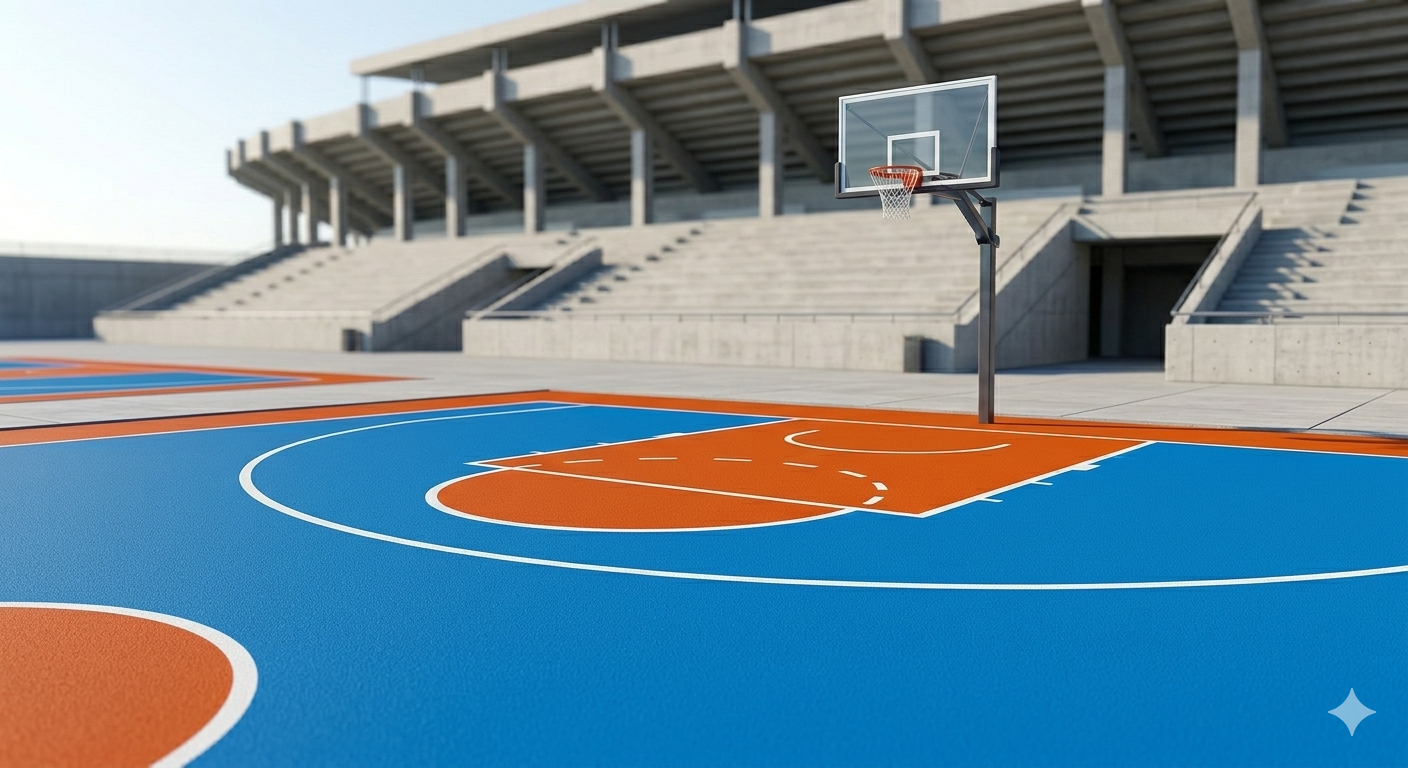
A single multi-sport surface accommodating basketball, volleyball, and badminton markings is the most popular choice for Indian schools with limited space
3. Facility Types: What Schools Typically Build
School sports facilities fall into a few broad categories. Understanding what each involves — and what it costs — helps you set realistic expectations from the outset.
Multi-Sport Court Most popular for Indian schools — maximum sport coverage per square foot
A single outdoor court with markings for basketball, volleyball, and badminton is the workhorse of school sports infrastructure. Built on a concrete base with an acrylic or PU surface, it can serve dozens of different activities with minimal additional cost. Most standard school multi-sport courts are approximately 28m x 16m — large enough to accommodate a full basketball court, which in turn fits two badminton courts lengthwise and a volleyball court.
Indoor Badminton Courts High demand in south India and urban private schools
Badminton is India's second most popular racquet sport and is growing rapidly in schools. A proper badminton court requires a dedicated indoor space — the shuttle is too sensitive to wind for outdoor play. A pair of courts (the most common school configuration) fits in a hall of approximately 26m x 20m with a minimum ceiling height of 9m. PVC vinyl or PU flooring is the standard; wooden sprung floors are used in premium academies.
Synthetic Turf Football / Cricket Ground Premium school investment — highest ROI for large campuses
A 5-a-side synthetic turf football pitch or a cricket practice net with turf surface is increasingly seen in larger school campuses (typically 3+ acres). For a full football pitch (68m x 105m), synthetic turf is rarely feasible in school budgets, but a 5-a-side pitch (40m x 25m) is entirely achievable. Cricket practice nets with synthetic turf pitches are popular across school budgets and can be installed for ₹8–15 lakh for a 3-net configuration.
Running Track EPDM or PU surface — fits even in compact campuses as a straight track
A full 400m running track is the aspiration for many schools but the reality for very few. Even a 200m track requires roughly 90m x 70m of land — a footprint available only in larger residential or CBSE campus schools. However, a 100m straight sprint track, or a simple 4-lane 60m track alongside the multi-sport court, is achievable on most campuses with 1+ acre of land. EPDM rubber is the most common surface for school tracks due to its durability, shock absorption, and relatively modest cost.
4. Surface Materials for School Facilities
Surface choice for school facilities involves a different set of priorities than commercial or professional venues. Durability, safety, low maintenance, and lifecycle cost are more important than peak performance characteristics. Here's how the main options stack up for school applications.

EPDM rubber surfaces are the most popular choice for school running tracks and multi-purpose play areas — durable, safe, and low-maintenance
Acrylic Hard Court (most popular): The default choice for outdoor multi-sport courts in schools. Multiple coats of acrylic resin on a concrete base create a durable, weather-resistant surface that needs minimal attention beyond an annual pressure wash. Indian-manufactured acrylic systems from reputable suppliers will last 10–15 years with basic care. Cost: ₹55–90 per sq ft for the surface layer. Total court construction including base: ₹18–30 lakh for a standard basketball-sized court.
PU (Polyurethane) Flooring: A step up from acrylic in terms of cushioning and player comfort. PU is standard for indoor school courts — badminton halls, basketball practice areas, and gymnasiums. It provides better shock absorption, reducing the risk of joint injuries for young athletes. Cost: ₹90–150 per sq ft for the surface layer.
EPDM Rubber: The go-to surface for running tracks and multi-purpose play areas. EPDM is highly durable, extremely safe (good grip in wet conditions, excellent shock absorption), and available in a range of colours. It performs well under the UV and heat stress typical of Indian conditions. Cost: ₹180–280 per sq ft installed for a standard track surface.
PVC Vinyl: Used almost exclusively in indoor courts — particularly badminton. International brands like Gerflor and Taraflex are the benchmark; Indian and Chinese alternatives offer lower-cost options with acceptable performance for school use. PVC vinyl is easy to clean, provides good grip, and is BWF-compliant. Cost: ₹120–200 per sq ft installed.
Synthetic Turf: For football, cricket nets, or general play areas. The pile height, infill type, and backing quality matter enormously. For school football pitches, a 40mm–50mm pile height with sand and SBR rubber infill is standard. Lower-cost options (shorter pile, no infill) are sometimes used for cricket practice nets and multi-use play areas. Cost: ₹200–450 per sq ft installed, depending on specification.
For outdoor courts — choose acrylic. For indoor sports halls — choose PU or PVC vinyl. For running tracks and play areas — choose EPDM. For grass-replacement grounds — choose synthetic turf with appropriate specification. Mixing categories (e.g., using outdoor surfaces indoors) always causes problems.
5. Realistic Cost Breakdown for School Projects
Here is a realistic cost table for the most common school sports facility configurations in India in 2026. All figures include civil works, surface, basic enclosure/fencing, and lighting where applicable.
| Facility Type | Specification | Budget Range (₹) | Notes |
|---|---|---|---|
| Outdoor Multi-Sport Court | Basketball + volleyball + badminton markings, acrylic surface, fencing, LED lights | ₹18–32 lakh | Most popular school investment; covers 5–6 sports |
| Two Outdoor Basketball Courts | Dual-court acrylic, shared fencing, lights | ₹28–48 lakh | For schools with higher student enrolment |
| Indoor Badminton Hall (2 courts) | PEB structure, PVC vinyl surface, LED lights, fans | ₹45–80 lakh | Includes structural hall; surface alone is ₹8–15 lakh |
| 5-a-side Synthetic Turf Pitch | 40mm turf, concrete base, fencing, lights | ₹28–50 lakh | Can double as cricket practice area |
| Cricket Practice Nets (3-net) | Synthetic turf pitch, net enclosure, matting run-up | ₹8–15 lakh | High-ROI addition for any school in India |
| 100m Sprint Track (4-lane) | EPDM rubber surface, lane markings, edge kerbing | ₹12–22 lakh | Doubles as long jump / throw runup area |
| School Gymnasium / Fitness Room | Rubber flooring, basic equipment, mirrors, ventilation | ₹10–25 lakh | Equipment cost variable; flooring is ₹3–6 lakh |
| Comprehensive Sports Complex | Multi-sport court + track + cricket nets + gymnasium | ₹70 lakh – ₹2 crore | For campus schools (3+ acres); phased development typical |
Important: These are indicative ranges. Actual costs depend on city, soil conditions, access, structural complexity, and specification choices. Always obtain at least 3 competitive quotes and ensure your contractor provides a detailed bill of quantities (BOQ).
6. Khelo India and Government Funding: What's Available
The Khelo India programme, launched by the Ministry of Youth Affairs and Sports in 2018, has emerged as the most significant driver of school-level sports infrastructure funding in India. The scheme operates across several verticals, each relevant to schools and educational institutions.
Khelo India School Games (KISG)
Beyond competitions, KISG feeds into infrastructure allocation for schools that are designated as Khelo India centres. Schools identified as having competitive athletes or potential talent pools may be eligible for infrastructure grants to upgrade their facilities. The process involves state-level nominations through the State Sports Authorities, who then forward approved projects to the Sports Authority of India (SAI).
Khelo India Infrastructure Development
Under the broader Khelo India umbrella, the central government allocates funds for the creation or upgradation of sports infrastructure at existing government schools, particularly in Tier 2, Tier 3, and rural areas. Applications are processed through the State Departments of Education and Sports. As of 2026, the scheme has supported over 1,000 school-level infrastructure projects across India, with grants ranging from ₹15 lakh to ₹2 crore depending on the facility type and state.
State-Level Schemes
Many states have their own parallel schemes. Uttar Pradesh's Khelo UP, Maharashtra's sports infrastructure grants under the School Education Department, Tamil Nadu's CM Sports Development Scheme, and similar programmes in Telangana, Gujarat, and Rajasthan provide additional funding channels for government-aided and private-aided schools. Private unaided schools typically do not qualify for direct grants but may benefit from soft loans under certain state schemes.
CSR Funding for School Sports Infrastructure
Under India's Companies Act 2013, companies are required to spend 2% of their average net profit on CSR activities — and sports promotion and infrastructure development are explicitly eligible CSR activities under Schedule VII. Many schools in industrial corridors and economic zones have successfully accessed CSR funding from local businesses for sports infrastructure. Building a compelling proposal that ties the facility to community outcomes, athlete development, and measurable impact is the key to securing CSR investment.
Government schools should apply through their District Education Officer (DEO) and State Sports Authority simultaneously. Private schools can partner with government bodies to access infrastructure funding jointly. The process requires detailed DPRs (Detailed Project Reports) — engaging an experienced sports infrastructure contractor early ensures your DPR meets the technical and financial standards required by SAI.

Khelo India-funded running tracks and courts are transforming sports access for students in government schools across India
7. Maintenance Planning for School Facilities
Sports facilities in schools are often built well but maintained poorly — and this is where the real lifecycle cost problems emerge. A ₹25 lakh court that is neglected for 5 years may require a ₹10 lakh refurbishment, while the same court with basic annual maintenance would last 15+ years with minimal intervention.
The key maintenance tasks for school sports facilities are straightforward. Outdoor acrylic courts need an annual pressure wash (₹5,000–8,000), periodic crack inspection, and line repainting every 3–5 years (₹15,000–25,000). EPDM tracks need clearing of debris, especially after monsoon, and inspection of joins and edges. Synthetic turf requires periodic brushing to maintain pile orientation and checking of infill levels — infill settles over time and needs top-up every 2–3 years (₹20,000–40,000 per pitch).
Indoor PVC vinyl flooring should be mopped regularly and inspected for lifting or bubbling at the edges — moisture ingress under the vinyl is the most common failure mode and can usually be repaired early for under ₹10,000. Catching it late means relaying entire sections.
Schools should allocate ₹30,000–₹80,000 per year in their annual budget for sports facility maintenance, depending on the size of the installation. This is a small fraction of construction cost and a sound investment in asset preservation.
8. Common Mistakes Schools Make (and How to Avoid Them)
Choosing the lowest bidder without evaluating quality: In tendering for sports infrastructure, the cheapest bid almost always reflects shortcuts in the sub-base, surface material quality, or infill specification. Require a detailed BOQ from all bidders and compare line by line, not just total price. A 15% lower quote that uses a 75mm concrete base instead of 100mm will cost you far more in repairs within 5 years.
Skipping proper drainage: Indian schools are often built on flat land without adequate storm water drainage. A sports court without proper slope and perimeter channels will pool water, stain the surface, and accelerate surface degradation. Drainage engineering must be part of the design from the beginning, not an afterthought. See our detailed article on why drainage is foundational to sports facility design.
Choosing the wrong surface for the climate: A surface that performs well in Pune may fail in Guwahati. High UV in Rajasthan, extreme humidity in coastal regions, freeze-thaw cycles in Himachal Pradesh and Uttarakhand — all require surface systems that are specified for local conditions. Always ask your contractor whether their recommended system has been successfully installed in similar climatic zones.
Under-specifying lighting: School sports often happen in the early morning and evening, especially in India's summer months when midday temperatures make outdoor activity dangerous. Courts without adequate lighting become unusable for much of the day. Budget for a minimum of 150–200 lux for recreational school courts; competitive training areas need 300 lux or more.
No phased plan: Schools with limited initial budgets often build one facility and then stop. A better approach is to design a master plan for the entire sports zone — even if you only build phase 1 in year one — so that future additions can integrate seamlessly with the existing infrastructure. Land reservation, drainage design, and electrical supply should be planned for the full buildout from the outset.
9. Key Takeaways and Next Steps
Building sports infrastructure for a school in India is both a long-term investment and a statement of intent about the kind of institution you're building. The decisions you make on surface materials, civil specifications, and facility design will determine the quality of sport your students can play for the next 15–20 years.
The most important first step is a site survey and a clear brief. Know your land constraints, your budget ceiling, and your sport priorities before engaging any contractor. With that clarity, getting competitive, comparable quotes becomes far more straightforward.
If your school qualifies for Khelo India or state-level funding, engage with your District Education Officer and State Sports Authority early — the application process takes time, and infrastructure projects that are ready with DPRs get processed faster than those that are conceptual. For private schools, exploring CSR partnerships with local businesses is a genuinely viable route to co-funding major infrastructure.
Finally, build in a maintenance budget from day one. The best-built sports surface will disappoint within a decade if it isn't cleaned, inspected, and repaired on schedule. A modest annual allocation — proportionate to the asset value — ensures your investment delivers its full expected lifespan.
Planning a Sports Facility for Your School?
Durosport has delivered over 200 sports infrastructure projects across India, including schools, academies, and government facilities. Get expert advice tailored to your campus, budget, and sport priorities.